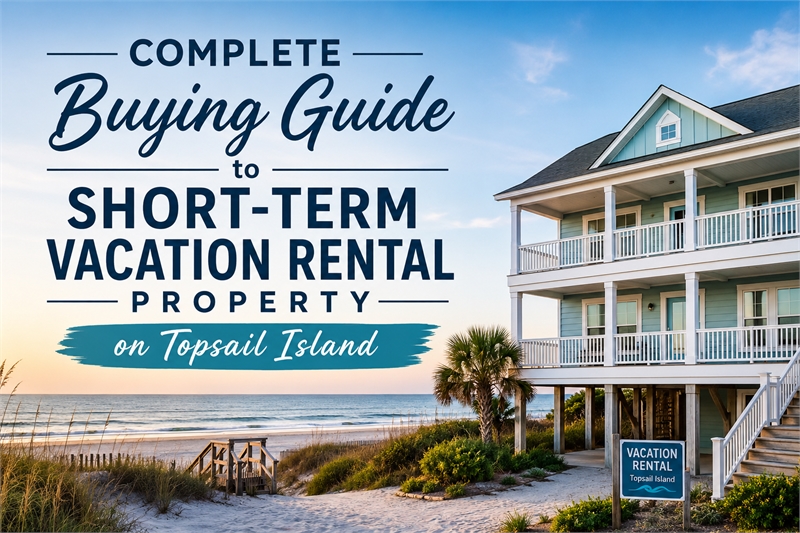
Complete Buying Guide to Short-Term Vacation Rental Property on Topsail Island
A comprehensive, investor-focused guide to purchasing and operating short-term vacation rental properties on Topsail Island. Covers zoning, HOAs, insurance, flood risk, income modeling, remote ownership considerations, and management strategies.
Purchasing a short-term vacation rental investment property on Topsail Island involves a distinct set of financial, regulatory, and operational considerations that differ materially from buying a primary residence or long-term rental. Coastal exposure, seasonal demand, insurance requirements, HOA governance, and local zoning rules all directly affect investment performance.
This guide provides a comprehensive, investor-focused overview of buying, operating, and evaluating short-term vacation rental properties on Topsail Island, including Surf City, North Topsail Beach, Topsail Beach, and nearby mainland access points. It is designed to serve as a central reference for buyers seeking accurate, locally grounded information before purchasing.
Investors looking for a practical framework to evaluate location, property type, rental performance, and long-term risk should also review How to Find the Perfect Vacation Rental Investment Property on Topsail Island.
Understanding Short-Term Rental Investment on Topsail Island
Short-term rentals on Topsail Island are typically defined as stays of fewer than 30 nights and are governed by a combination of state law, municipal ordinances, and private HOA rules. Demand is driven primarily by family tourism, beach access, seasonal travel, and limited hotel inventory.
Unlike year-round urban rental markets, Topsail Island rentals are highly seasonal, with the majority of gross revenue generated during peak summer months. Investors must evaluate income on an annualized, seasonally weighted basis rather than relying on average nightly rates alone.
For buyers weighing personal use against income generation, our article Vacation Rental vs Primary Residence on Topsail Island explains how ownership goals affect financing, insurance requirements, and long-term investment strategy.
Location Matters: Town-by-Town Investment Considerations
Surf City
Surf City offers strong rental demand, walkability in certain areas, and proximity to dining and entertainment. At the same time, it has higher regulatory oversight, parking enforcement, and a greater prevalence of HOAs that may impose rental restrictions.
North Topsail Beach
North Topsail Beach is characterized by larger homes, strong weekly family rentals, and fewer commercial amenities. Properties here often experience higher exposure to erosion, wind, and flood risk, which can materially affect insurance costs.
Topsail Beach
Topsail Beach maintains lower density and stricter zoning controls. Rental demand is steady but more subdued, appealing to repeat visitors seeking a quieter experience. Regulatory compliance and setback rules are especially important in this area.
Buyers comparing newer construction with older coastal homes should also review New Construction vs Existing Homes on Topsail Island, which outlines differences in insurance costs, maintenance demands, and long-term durability, along with Buying a Home on Topsail Island: Town-by-Town Differences That Matter, which explains how location influences regulations, costs, and long-term ownership considerations.
Zoning, STR Rules, and Regulatory Compliance
Short-term rental permissibility is not uniform across the island. Investors must verify:
- Zoning district allowances
- Registration or permitting requirements
- Occupancy and parking limits
- Noise and enforcement policies
Short-term rental permissions vary by municipality. For a detailed breakdown by town and zoning district, see Zoning and Short-Term Rental Rules on Topsail Island.
Properties governed by associations require additional review, which is covered in HOA, Condo, and Insurance Considerations for Topsail Island Home Buyers.
In addition to municipal rules, HOA governing documents may impose stricter rental limitations than town ordinances. HOA restrictions remain enforceable even when municipal zoning allows STR use.
HOA Governance and Risk for Investors
HOAs represent one of the most significant risk variables for short-term rental investors on Topsail Island. Buyers should review:
- Rental caps or prohibitions
- Annual budgets and reserve funding
- History of special assessments
- Insurance coverage for common elements
- Maintenance responsibilities
HOA financial health directly affects cash flow, resale value, and exposure to unplanned assessments, particularly following storms.
Investors evaluating condo or planned-community ownership should review HOA Considerations and Due Diligence on Topsail Island for a detailed analysis of reserves, assessments, insurance gaps, and rental restrictions.
Insurance, Flood Zones, and Coastal Exposure
Short-term rental properties on Topsail Island often require layered insurance coverage, including homeowners insurance, wind and hail coverage, flood insurance, and liability endorsements.
Flood insurance is mandatory for properties located in federally designated flood zones when financed with a federally backed mortgage. Premiums vary based on elevation, structure type, and location.
Because many private insurers exclude wind coverage in coastal areas, North Carolina established the Beach Plan, a state-backed pool that provides wind and hail insurance for eligible properties.
If storm damage exceeds 50% of a structure’s value, repairs are considered “substantial damage,” requiring the home to meet current building codes, flood regulations, and setback rules, which may be more restrictive than when the home was built.
Flood exposure, elevation requirements, and insurance cost differences are examined in detail in Flood Zones, Elevation, and Coastal Risk on Topsail Island, which is essential reading for coastal investors.
Financial Modeling for STR Investments
Responsible investment analysis requires conservative assumptions and full cost accounting. Buyers should evaluate:
- Seasonally weighted rental income
- Property management fees
- Cleaning and turnover costs
- Maintenance reserves
- Insurance premiums and deductibles
- HOA dues and assessments
- Property taxes
Gross annual income for a standard 4-bedroom Topsail Island home commonly ranges from $50,000 to $75,000, while oceanfront estates may exceed that range. Revenue is highly concentrated in summer months, with peak periods averaging over $9,000 per month and daily rates near $489, depending on location and condition.
Financing Short-Term Rental Properties
Lenders typically impose stricter requirements for vacation rentals than for primary residences. Down payments often start at 20% to 25%, and some lenders exclude projected rental income from qualification calculations.
Loan structure, interest rate risk, and reserve requirements should align with the investor’s holding strategy and tolerance for income volatility.
Buyer Considerations for Out-of-State and Remote Vacation Rental Owners
Purchasing a short-term vacation rental on Topsail Island while living out of state or at a significant distance introduces additional operational risks that must be addressed before closing. Unlike primary residences, vacation rentals require ongoing physical oversight, rapid response capability, and dependable local support to protect both income and asset condition.
Physical Distance and Property Oversight
Remote owners do not have the ability to conduct regular visual inspections or respond quickly to unexpected issues. Coastal properties, in particular, are more susceptible to damage from humidity, salt air, storms, and guest turnover, making routine on-site monitoring essential.
Without regular visual confirmation, issues such as roof leaks, water intrusion, HVAC failures, plumbing leaks, or storm damage can escalate before they are discovered through guest reports or automated alerts. Investors should plan for:
- Scheduled physical inspections throughout the year
- Post-storm property checks
- Preventative maintenance walk-throughs
- Verification of cleaning and turnover quality
Owners who cannot personally perform these tasks must rely on trusted local professionals with physical access to the property.
Emergency Access and Contractor Coordination
One of the most overlooked challenges for out-of-state owners is emergency access. When urgent repairs are required, contractors must be able to access the property immediately. Delays caused by unavailable owners, missing keys, or unclear authorization can result in:
- Cancelled bookings
- Guest relocation costs
- Property damage escalation
- Negative reviews
Remote owners should ensure that at least one local party has authorized access to the property and clear authority to approve emergency repairs when the owner is unavailable.
Management Structure Options for Remote Owners
Choosing the correct management structure is a critical decision for investors who do not live nearby. Each option carries distinct levels of control, cost, and risk.
Self-Management
Self-management places full responsibility on the owner for bookings, guest communication, maintenance coordination, and emergency response. While this approach can reduce management fees, it is generally not practical for out-of-state owners unless they have reliable, on-call local support.
Risks include delayed responses, limited oversight, and increased exposure during peak season or storm events.
Traditional Property Management
Full-service property management firms handle bookings, guest services, cleaning coordination, and basic maintenance oversight. This option provides structure and local presence but often comes with:
- Higher percentage-based fees
- Limited owner control over pricing and maintenance decisions
- Additional administrative or service charges
For remote owners, traditional management offers predictability but requires careful contract review to understand cost structures and response protocols.
Co-Hosting Services
Co-hosting is a hybrid model that allows owners to retain pricing and booking control while delegating on-the-ground responsibilities such as inspections, guest coordination, and emergency response.
For many out-of-state investors, co-hosting offers a balance between operational oversight and cost efficiency, particularly when paired with established local contractor relationships.
Co-hosting is often preferred by owners who want professional, local support without giving up pricing and booking control, which is explored in detail in Built for Rental Owners, by a Topsail Island Rental Owner.
Importance of Local Relationships
Regardless of management structure, remote owners benefit significantly from established relationships with:
- Local contractors and service providers
- Cleaning and turnover crews
- Property inspectors or caretakers
- Neighboring property owners or HOAs
These relationships provide real-time insight into property conditions and help ensure faster response during emergencies or peak demand periods.
Risk Mitigation for Remote Owners
Out-of-state investors should plan for redundancy and accountability by ensuring:
- Multiple points of local contact
- Clear written authorization for emergency repairs
- Defined inspection schedules
- Transparent communication protocols
Proper planning reduces downtime, protects rental income, and helps preserve long-term property value.
Property Management and Operational Costs
Management options include full-service property management, co-hosting models, and owner self-management. Beyond standard percentage-based fees, some management companies charge:
- Per-booking fees
- Linen or starter-kit fees
- Administrative charges
- Markups on maintenance service calls
All management contracts should be reviewed carefully prior to signing.
Frequently Asked Questions About Buying a Vacation Rental on Topsail Island
Financial & Investment FAQs
What are the down payment requirements?
Most lenders require 20% to 25% down for short-term rental investment properties.
How much rental income can I expect?
A typical 4-bedroom home may gross $50,000–$75,000 annually, with significant seasonal variation.
Property-Specific FAQs
Do all properties have HOAs?
No. Many condos and newer developments do, while older single-family homes may not.
Are public pools available on Topsail Island?
No. All pools are private or HOA-restricted.
What is the North Carolina Vacation Rental Act?
It governs rentals under 90 days and requires a written rental agreement, providing consumer protections.
Insurance & Coastal Regulation FAQs
Is flood insurance mandatory?
Yes, for properties in federally designated flood zones with federally backed mortgages.
What is the Beach Plan?
A state-backed wind and hail insurance program for coastal properties.
Can I rebuild after major damage?
If damage exceeds 50% of value, rebuilding must comply with current regulations.
STR Rules & Taxes FAQs
Are short-term rentals restricted?
Rules vary by town, zoning district, and HOA.
Are accommodation taxes required?
Yes. Owners must collect and remit approximately 13% in state and local taxes, including local occupancy taxes in some areas.
FAQs for Out-of-State and Remote Vacation Rental Owners
What are the biggest risks for out-of-state vacation rental owners?
The primary risks include delayed response to maintenance issues, lack of regular visual inspections, limited emergency access for contractors, and slower reaction to storm-related damage. These risks are amplified in coastal environments where weather, humidity, and salt exposure accelerate wear.
How often should a remote owner have the property physically inspected?
Remote owners should arrange scheduled visual inspections at least quarterly, with additional inspections:
- After major storms or hurricanes
- Before and after peak rental season
- When extended vacancies occur
Routine inspections help identify issues that may not be reported by guests or automated monitoring systems.
Who should have physical access to the property if the owner lives out of state?
At least one local, trusted party should have authorized access at all times. This may include:
- A property manager or co-host
- A trusted contractor or caretaker
- A designated local representative
This access is critical for emergency repairs, inspections, and storm response.
Is self-management realistic for out-of-state owners?
Self-management is generally not recommended for owners who live far from the property unless they have dependable, on-call local support. Without local presence, response delays can result in booking cancellations, guest relocation costs, and property damage escalation.
What is the difference between property management and co-hosting for remote owners?
Traditional property management typically provides full-service oversight but at higher cost and reduced owner control.
Co-hosting allows owners to retain pricing and booking authority while delegating on-the-ground responsibilities such as inspections, guest coordination, and emergency response. Many remote owners prefer co-hosting for greater transparency and flexibility.
How do remote owners handle emergency repairs when they are unavailable?
Remote owners should establish written authorization protocols allowing local representatives or managers to approve emergency repairs up to a defined dollar amount. This prevents delays that could worsen damage or disrupt guest stays.
Are remote owners at higher risk during hurricane season?
Yes. Remote owners are more vulnerable to delayed damage assessment and mitigation following storms. Pre-arranged post-storm inspections, contractor relationships, and access authorization significantly reduce this risk.
What local relationships are most important for out-of-state owners?
Remote owners benefit most from established relationships with:
- Reliable local contractors
- Cleaning and turnover services
- Property caretakers or inspectors
- HOA contacts (if applicable)
These relationships provide real-time visibility into property condition and faster problem resolution.
Can remote ownership impact guest reviews?
Yes. Delayed maintenance responses, unresolved issues, or inconsistent property condition can negatively affect guest reviews. Proper local oversight and response planning help protect both guest experience and listing performance.
What is the best way for remote owners to reduce operational risk?
Risk is best reduced through:
- Regular inspections
- Clear emergency access procedures
- Defined management responsibilities
- Redundant local contacts
- Transparent communication systems
Proactive planning is essential for maintaining income stability and property value.
Keep reading