
Zoning and Short-Term Rental Rules on Topsail Island
An overview of zoning and short-term rental rules on Topsail Island, explaining town regulations, permit requirements, minimum stays, and tax compliance for property owners.
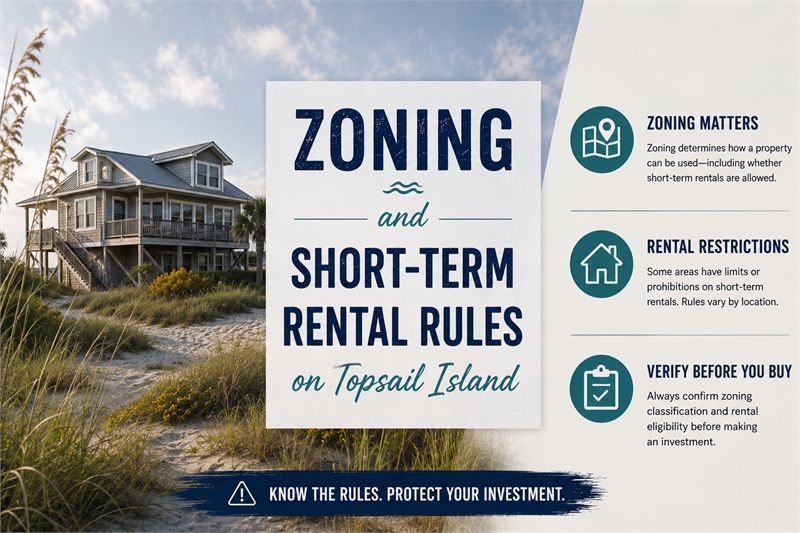
What Property Owners and Buyers Need to Understand
Short-term rentals are a significant part of the coastal housing landscape on Topsail Island, but operating a vacation rental is regulated at both the municipal and state level. Zoning classifications, permitting requirements, and tax obligations vary by town, and compliance plays a critical role in protecting both rental income and long-term property value.
Buyers considering rental use—whether occasional or investment-focused—should understand how short-term rental rules are enforced across the island.
Town-Level Zoning and Rental Regulations
Topsail Island is governed by three separate municipalities, each of which enforces its own ordinances related to short-term rentals.
North Topsail Beach
North Topsail Beach is primarily residential, with a large concentration of condominium communities. Short-term rentals are common, but they are regulated through local ordinances.
Typical requirements include:
- Registration or permitting of rental properties
- Compliance with zoning classifications
- Adherence to occupancy limits
- Annual or periodic permit renewals
Certain condominium communities may also impose additional restrictions through HOA rules that supersede town allowances.
Surf City
Surf City functions as the commercial and activity center of the island and supports a robust short-term rental market.
Regulatory features often include:
- Mandatory short-term rental permits
- Defined minimum stay requirements
- Local inspections or safety compliance standards
- Renewal deadlines tied to calendar or fiscal years
Because Surf City has higher year-round activity, enforcement and compliance monitoring may be more structured compared to quieter residential areas.
Topsail Beach
Topsail Beach is known for lower-density development and a strong emphasis on preserving a small-town coastal atmosphere.
Short-term rental regulations typically focus on:
- Maintaining neighborhood character
- Registration and permitting
- Noise, parking, and occupancy standards
Topsail Beach may impose stricter use limitations in certain zoning districts, particularly near residential or soundside areas.
Common Permit and Registration Requirements
Across all three towns, short-term rental owners generally encounter similar administrative requirements, though details vary.
Common elements include:
- Initial permit or registration application
- Annual or recurring renewals
- Designation of a local responsible party or property manager
- Posting of permit numbers on rental listings
Failure to maintain active registration can result in fines, penalties, or suspension of rental privileges.
Minimum Stay Rules and Use Limitations
Minimum stay requirements are often used by municipalities to balance tourism with residential use.
Examples may include:
- Weekly rental minimums during peak season
- Shorter minimum stays during off-season months
- Restrictions on event-related or short-term occupancy
These rules can affect rental strategy and income planning, particularly for owners targeting weekend or shoulder-season bookings.
Taxes and Occupancy Compliance
Short-term rentals on Topsail Island are subject to state and local occupancy taxes.
Owners are generally responsible for:
- Collecting state sales tax
- Collecting county occupancy taxes
- Collecting any applicable municipal occupancy taxes
- Filing and remitting taxes on required schedules
Some booking platforms assist with tax collection, but owners remain ultimately responsible for compliance.
HOA and Community-Level Restrictions
In addition to town regulations, many condominium communities and planned neighborhoods enforce their own rental rules through HOA governing documents.
These restrictions may include:
- Prohibitions on short-term rentals
- Minimum lease durations
- Caps on the number of rental units
- Registration or approval requirements
HOA rules can be more restrictive than municipal ordinances, making HOA document review an essential part of buyer due diligence.
Why Compliance Matters for Long-Term Value
Maintaining compliance with zoning, permitting, and tax regulations protects both rental income and resale value.
Non-compliance can result in:
- Fines or penalties
- Loss of rental privileges
- Legal disputes with municipalities or HOAs
- Increased scrutiny during property resale
For investors and owners relying on rental income, regulatory compliance is a core component of risk management.
Frequently Asked Questions (FAQ)
Are short-term rentals allowed everywhere on Topsail Island?
Not necessarily. Allowance depends on zoning, municipal ordinances, and HOA rules.
Do all towns require rental permits?
Each town enforces its own registration or permitting process, though requirements vary.
Are occupancy taxes required for vacation rentals?
Yes. State and local occupancy taxes typically apply to short-term rentals.
Can HOA rules override town regulations?
Yes. HOAs may impose stricter rules than municipal ordinances.
Do rental rules change over time?
Yes. Municipal ordinances and HOA rules may be amended, making ongoing review important.
This guide is included in The Complete Buyer’s Guide to Topsail Island Real Estate, a broader resource designed to help buyers understand the local market, property options, and ownership considerations.
Keep reading