Financing Coastal Property on Topsail Island
An in-depth guide to financing coastal property on Topsail Island, including mortgage considerations, insurance requirements, loan options, and financing tips for buyers and investors.
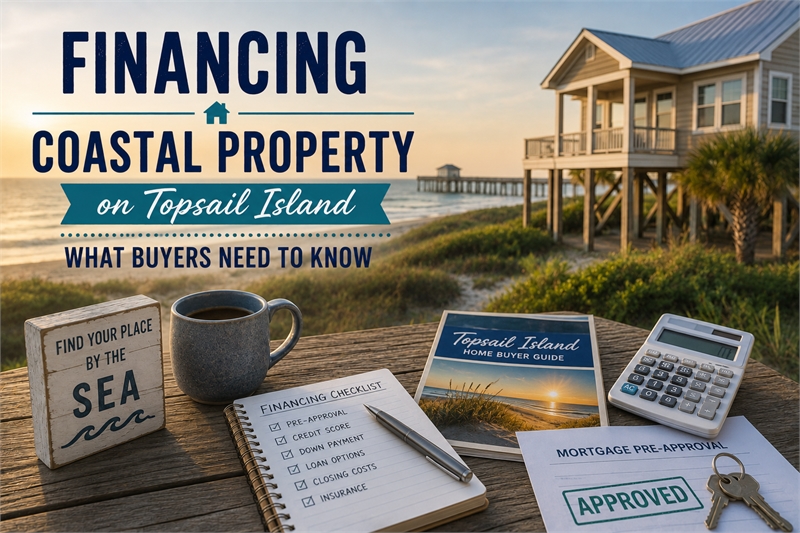
What Buyers and Investors Need to Know
Financing property on Topsail Island differs in important ways from financing inland residential real estate. Coastal location, insurance requirements, property use, and loan size all influence how lenders evaluate risk and structure mortgage terms. For buyers considering a primary residence, second home, or investment property on Topsail Island, understanding these factors early can help avoid delays and unexpected complications.
While many transactions proceed smoothly, coastal financing often involves additional documentation and underwriting considerations that are specific to barrier island markets.
Mortgage Considerations for Coastal Properties
Higher Down Payment Requirements
One of the most common differences in coastal financing is down payment expectations. Depending on the loan type, property use, and borrower profile, lenders may require higher down payments than those typically associated with inland properties.
Factors that influence down payment requirements include:
- Whether the property is a primary residence, second home, or investment property
- Loan size relative to conforming limits
- Property type, such as condominium versus single-family home
- Overall borrower credit profile
Second homes and investment properties generally carry higher down payment thresholds than owner-occupied primary residences.
Flood and Wind Insurance Verification
Insurance plays a central role in coastal financing. Properties on Topsail Island are commonly located in designated flood zones, requiring flood insurance in addition to standard homeowners insurance.
Lenders typically verify:
- Active flood insurance coverage when required
- Wind and hazard insurance policies
- Coverage amounts that meet loan requirements
Insurance premiums and coverage details are reviewed during underwriting, and proof of insurance is usually required before closing. These requirements are standard for coastal properties and are designed to protect both the borrower and the lender.
Rental Income Documentation for Investors
For buyers purchasing rental or income-producing properties, lenders may consider projected or existing rental income as part of the qualification process.
Common documentation requests include:
- Existing rental history, if available
- Short-term rental projections from recognized sources
- Management agreements or contracts
- Lease agreements for long-term rentals
Rental income is typically evaluated conservatively, and not all projected income may be counted toward qualification. This approach reflects the seasonal nature of coastal rental markets.
The Role of Local and Coastal-Experienced Lenders
Working with lenders familiar with coastal markets can simplify the financing process. Local or regional lenders with experience on Topsail Island often understand:
- Flood zone classifications
- Insurance requirements
- Common property types and HOA structures
- Seasonal rental dynamics
This familiarity can reduce delays related to documentation requests and underwriting clarification, particularly for condominium communities and oceanfront properties.
Common Loan Types Used on Topsail Island
Conventional Loans
Conventional mortgages remain one of the most widely used financing options for coastal properties. These loans are typically used for:
- Primary residences
- Second homes
- Some investment properties
Eligibility and terms depend on credit profile, loan size, and property classification. Conventional loans often offer competitive rates but may involve stricter down payment and insurance requirements for non-primary residences.
Jumbo Loans
Given coastal property values and oceanfront pricing, jumbo loans are common on Topsail Island.
Jumbo loans:
- Exceed conforming loan limits
- Often require higher credit scores
- Typically involve larger down payments
- May have additional reserve requirements
Borrowers using jumbo financing should expect more detailed financial review as part of the underwriting process.
VA Loans (Eligible Buyers)
Eligible buyers may use VA loans to purchase property on Topsail Island, subject to program guidelines.
VA loans can offer:
- No down payment options
- Competitive interest rates
- Flexible qualification standards
However, VA loans are generally limited to primary residences and must meet specific property condition and appraisal standards. Condominium eligibility may also depend on VA approval status.
Second-Home Financing
Many Topsail Island purchases are classified as second homes rather than investment properties. Second-home financing often offers more favorable terms than investor loans but still requires:
- Proof that the property is not used as a full-time rental
- Higher down payments than primary residences
- Insurance and occupancy verification
Correctly classifying property use is important, as misclassification can lead to underwriting issues.
Condominium-Specific Financing Considerations
Condominium financing involves additional review beyond individual borrower qualifications. Lenders may evaluate:
- HOA financial health
- Insurance coverage for the building
- Percentage of owner-occupied units
- Ongoing maintenance and reserve funding
Not all condominium communities qualify equally across loan programs. Buyers should confirm financing eligibility early when considering condo purchases.
Timing and Preparation
Because of additional documentation requirements, financing coastal property often benefits from early preparation.
Recommended steps include:
- Obtaining pre-approval from a coastal-experienced lender
- Reviewing insurance requirements before making an offer
- Understanding HOA documentation timelines
- Allowing flexibility in closing schedules
Advance planning helps reduce transaction friction and supports smoother closings.
Frequently Asked Questions (FAQ)
Is it harder to finance property on Topsail Island than inland homes?
It can be more complex due to insurance requirements and property classifications, but many buyers successfully finance coastal properties with proper preparation.
Do all properties require flood insurance?
Flood insurance is required for properties located in designated flood zones. Coverage requirements depend on location and lender guidelines.
Can rental income be used to qualify for a mortgage?
In some cases, yes. Lenders may consider rental income, but it is typically evaluated conservatively and requires documentation.
Are condominiums harder to finance than single-family homes?
They can be, depending on HOA financials, insurance coverage, and owner-occupancy ratios.
Should buyers work with local lenders?
Lenders familiar with coastal markets often streamline the process by understanding local insurance, zoning, and property characteristics.
This guide is included in The Complete Buyer’s Guide to Topsail Island Real Estate, a broader resource designed to help buyers understand the local market, property options, and ownership considerations.
Keep reading