HOA Considerations and Due Diligence on Topsail Island
A practical guide to HOA considerations on Topsail Island, explaining budgets, reserve funding, maintenance responsibilities, rental rules, and why HOA due diligence matters for buyers.
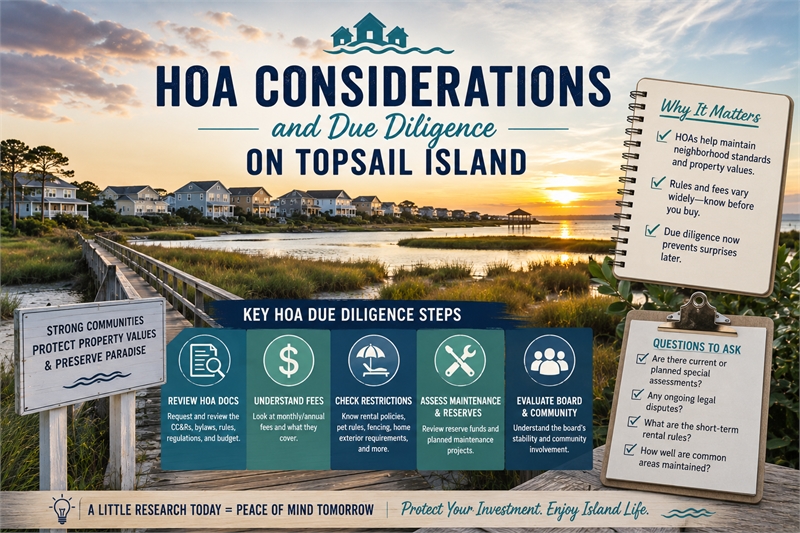
What Buyers Should Review Before Purchasing in Condominium and Planned Communities
Homeowners Associations (HOAs) play a central role in property ownership on Topsail Island, particularly for condominium communities and certain planned residential developments. While HOAs can provide structure, shared maintenance, and consistency, they also introduce financial and governance considerations that buyers should evaluate carefully before committing to a purchase.
Conducting thorough HOA due diligence helps buyers understand not only monthly dues, but also long-term financial health, maintenance planning, and restrictions that may affect future use or resale.
Why HOA Due Diligence Matters on a Barrier Island
Coastal properties are exposed to environmental factors such as salt air, wind, and storm events. On Topsail Island, HOAs are often responsible for maintaining shared infrastructure that directly affects property condition and long-term value.
A well-managed, adequately funded HOA can:
- Preserve building integrity
- Plan for major repairs and replacements
- Reduce the risk of unexpected assessments
- Support consistent property standards
Conversely, underfunded or poorly managed HOAs can introduce financial uncertainty and deferred maintenance risks.
Reviewing HOA Budgets
The HOA budget provides insight into how a community operates on a day-to-day basis.
Buyers should review:
- Annual operating budgets
- Allocation of funds for maintenance versus administrative expenses
- Insurance costs and coverage types
- Utility or service contracts paid through dues
A balanced budget typically reflects realistic expenses and demonstrates whether dues are aligned with the actual cost of operating and maintaining the community.
Understanding Reserve Studies and Reserve Funding
Reserve studies are one of the most important documents buyers can review, especially for condominium communities.
A reserve study evaluates:
- Major common-area components (roofs, siding, elevators, pools, walkways)
- Estimated useful life of each component
- Projected replacement or repair costs
- Recommended reserve funding levels
Well-funded reserves help ensure that major repairs can be handled without special assessments. Buyers should assess whether reserve balances appear consistent with the age, size, and complexity of the community.
Maintenance Responsibilities
Maintenance responsibilities vary widely between communities and should be clearly understood before purchase.
HOA responsibilities may include:
- Exterior building maintenance
- Roof repair and replacement
- Landscaping and common areas
- Amenities such as pools or fitness rooms
Unit owner responsibilities may include:
- Interior maintenance
- Appliances and fixtures
- Windows or doors (depending on governing documents)
Understanding this division of responsibility helps buyers anticipate future costs and obligations.
Rental Restrictions and Use Policies
Rental restrictions are a critical consideration for buyers planning to rent their property, either short-term or long-term.
HOA documents may address:
- Whether short-term rentals are permitted
- Minimum rental durations
- Occupancy limits
- Registration or approval requirements
Rental policies can significantly affect both usability and marketability. Buyers should confirm that intended use aligns with HOA rules, as these restrictions can change over time through amendments.
Special Assessments and Financial Risk
Special assessments are additional charges levied by an HOA to cover expenses not funded through regular dues.
While assessments are sometimes unavoidable, frequent or large assessments may indicate:
- Inadequate reserve funding
- Deferred maintenance
- Unexpected repair costs
Buyers should review recent assessment history and inquire about pending or anticipated projects that could impact future expenses.
Governance, Transparency, and HOA Management
HOA governance structure and management practices influence how effectively a community operates.
Important considerations include:
- Whether the HOA is self-managed or professionally managed
- Frequency of board meetings and owner communication
- Availability of financial reports and governing documents
- Responsiveness to maintenance and owner concerns
Transparent governance and professional management often correlate with better long-term outcomes.
HOAs and Long-Term Property Value
On Topsail Island, well-funded and proactively managed HOAs play a meaningful role in protecting long-term property value. Consistent maintenance, clear rules, and financial planning help communities weather both environmental exposure and market cycles.
Buyers evaluating HOA-governed properties should view dues not only as an expense, but as part of a broader system that supports asset preservation.
Frequently Asked Questions (FAQ)
Are all Topsail Island properties governed by HOAs?
No. HOAs are most common in condominium communities and some planned neighborhoods. Many single-family homes are not HOA-governed.
Should buyers avoid properties with high HOA dues?
Not necessarily. Higher dues may reflect extensive amenities, insurance coverage, or strong reserve funding. Buyers should evaluate what the dues cover.
Can HOA rules change after purchase?
Yes. HOA rules and bylaws can be amended according to governing documents. Buyers should understand amendment procedures.
Do reserve studies guarantee no future assessments?
No. Reserve studies reduce risk but cannot eliminate the possibility of assessments due to unforeseen events or cost changes.
Is HOA financial health disclosed during the purchase process?
Certain documents are typically provided during due diligence, but buyers should review them carefully and ask follow-up questions when needed.
This guide is included in The Complete Buyer’s Guide to Topsail Island Real Estate, a broader resource designed to help buyers understand the local market, property options, and ownership considerations.
Keep reading