Should You Buy a Condo on Topsail Island, NC in 2026?
Buying a condo on Topsail Island can provide coastal ownership and rental income, but it comes with risks. This guide covers HOA fees, insurance, community differences, and what buyers need to know before purchasing in 2026.
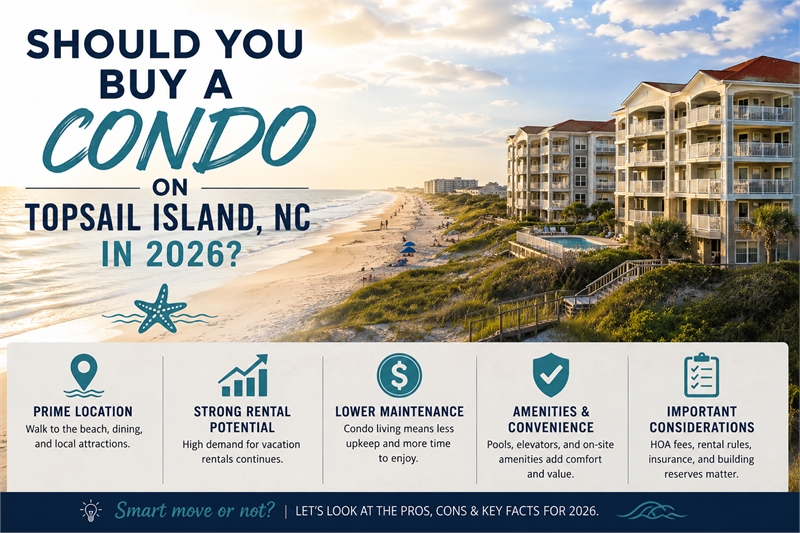
What Should Buyers Know Before Buying a Condo on Topsail Island?
Buying a condo on Topsail Island sounds straightforward—until you realize you’re not just buying a property.
You’re buying into a homeowners association, a shared financial structure, and a long-term cost system that most buyers don’t fully understand until after closing.
For many people entering the Topsail Island real estate market, condos represent the most practical and accessible path to ownership. Single-family homes—especially oceanfront—have climbed into price ranges that are simply not realistic for a large segment of buyers. It is now common to see homes priced well into the $800,000 to $2 million range depending on location and condition.
Condos fill that gap.
They allow buyers to gain access to the coastal lifestyle, own near or directly on the ocean, and participate in the vacation rental market without committing to the financial scale required for a detached home. In areas like North Topsail Beach, condo communities make up a significant portion of available inventory and are a major part of the island’s tourism-driven economy.
But there is a key difference that cannot be overlooked.
Buying a Condo Means Buying Into a Shared System
When you purchase a condo, you are not just buying the unit itself. You are buying into a shared structure, a homeowners association, and a collective financial system that determines how the property is maintained and how costs are distributed.
That system is what ultimately shapes your ownership experience.
If you want a deeper breakdown of how HOA-managed communities actually function on Topsail Island, you can learn more by checking out the full guide HOA, Condo, and Insurance Considerations for Topsail Island Home Buyers
What Are the Advantages of Buying a Condo on Topsail Island?
Despite the added complexity, condos remain highly attractive for several practical reasons.
Lower Cost of Entry Into Coastal Ownership
One of the most compelling advantages of condos is affordability relative to single-family homes. For buyers who want oceanfront access, condos often provide the only realistic opportunity to enter the market at a manageable price point.
Instead of committing to a seven-figure purchase, buyers can secure a beachfront or near-beachfront property at a significantly lower cost. This makes condos particularly appealing to first-time coastal buyers, second-home purchasers, and investors entering the vacation rental market.
Access to High-Demand Locations
Condo developments on Topsail Island are typically positioned in highly desirable locations. Many are built directly on the ocean or within immediate proximity to the beach.
Because these locations are limited and cannot be replicated, they continue to drive strong demand from both buyers and renters. Ownership in these areas is not simply about the unit—it is about securing access to a fixed, high-value location.
Simplified Maintenance and Ownership
Another advantage of condo ownership is the reduced responsibility for exterior maintenance. In most communities, the homeowners association handles major elements such as roofing, siding, landscaping, and shared infrastructure.
For buyers who do not live locally or prefer a more hands-off ownership experience, this can be a significant benefit. It allows owners to enjoy the property without managing ongoing repairs themselves.
Strong Vacation Rental Potential
Condos are one of the most common property types used for short-term rentals on Topsail Island. Their size, layout, and location make them well-suited for weekly vacation stays, especially during peak tourism months.
Oceanfront units, in particular, tend to generate consistent demand due to their visibility and direct beach access. For investors, this creates the potential to offset ownership costs through rental income.
For a more detailed look at rental income potential and what owners are actually seeing on the island, you can review the full investment guide Vacation Rental Investment Potential on Topsail Island
Long-Term Market Appreciation on Topsail Island
For buyers thinking beyond short-term rental income, long-term appreciation is a key part of the equation.
Topsail Island has historically benefited from limited supply and steady demand. As a barrier island, there is only a finite amount of land available—especially for oceanfront and near-ocean properties—which has helped support property values over time.
Demand has remained consistent as well. Second-home buyers, out-of-state purchasers, and investors seeking vacation rental opportunities continue to drive interest in the market. Unlike heavily overdeveloped coastal areas, Topsail Island has maintained more controlled growth, which has helped preserve its appeal and long-term value.
However, appreciation is not equal across all properties.
Condominiums are influenced not only by location, but also by HOA financial health, building condition, and long-term maintenance planning. Well-managed communities with strong reserves tend to hold value more consistently, while properties with deferred maintenance or financial instability can struggle.
Rising ownership costs are also becoming more important. Insurance premiums, HOA dues, and maintenance expenses can impact both affordability and resale demand. As a result, long-term value is tied not just to location, but to the overall strength of the community.
In practical terms, buyers who focus on well-maintained properties in desirable locations with strong HOA management are more likely to see consistent long-term value.
You can learn more about Topsail Island property appreciation in our article Long-Term Market Appreciation on Topsail Island.
What Are the Risks of Buying a Condo on Topsail Island?
While the advantages are clear, the risks are often underestimated.
HOA Fees and Long-Term Cost Increases
Homeowners association fees are a central part of condo ownership, and they rarely remain static. These fees fund maintenance, insurance, and operational costs for the community.
On a coastal property, costs fluctuate due to rising insurance premiums, increased maintenance needs, and exposure to storms. Over time, HOA fees can increase significantly, affecting long-term affordability.
To better understand the full cost of ownership—including property taxes, insurance, and long-term expenses—you can review the detailed breakdown in Average Property Taxes on Topsail Island: What Home Buyers Need to Know
Special Assessments
Special assessments represent one of the most significant financial risks for condo owners. These occur when the HOA requires additional funds for major repairs or improvements and does not have sufficient reserves.
Common examples include roof replacement, structural repairs, and storm-related damage. When these situations arise, owners may be required to contribute substantial additional funds beyond their regular dues.
Insurance Complexity
Insurance coverage for condos is more complicated than many buyers expect. While most associations carry a master policy, that coverage is typically limited to specific portions of the structure.
Individual owners are responsible for obtaining their own policies to cover interior elements, personal property, and any gaps not included in the master policy. Understanding this division of responsibility is critical.
If you’re unsure how coastal insurance works or what coverage you actually need, you can learn more with our full insurance guide Insurance Considerations for Buyers on Topsail Island
Limited Control Over Decision-Making
Condo ownership involves shared decision-making. Owners rely on the HOA and its governing board to manage maintenance, budgeting, and long-term planning.
A well-managed association can enhance property value and stability. A poorly managed one can lead to delayed repairs, financial strain, and declining conditions.
Are Condos on Topsail Island a Good Investment in 2026?
For many buyers, this is the question that ultimately drives the decision: not just whether they like the property, but whether it makes sense financially over the long term.
The honest answer is that condos on Topsail Island can be a strong investment—but only when the right factors align.
Location plays a major role. Oceanfront and high-demand areas—particularly those with direct beach access and strong visibility on rental platforms—tend to perform better in terms of both rental income and resale demand. Properties in more walkable areas, such as Surf City, may benefit from consistent occupancy due to their proximity to restaurants, shops, and attractions. In contrast, North Topsail Beach properties often appeal to buyers seeking quieter environments, which can still perform well but may attract a different type of renter.
HOA structure and financial health are just as important as location. A well-managed association with strong reserves, consistent maintenance, and clear long-term planning can protect property value and reduce the likelihood of unexpected costs. On the other hand, underfunded HOAs or communities with deferred maintenance can significantly impact profitability through rising dues or special assessments.
Rental performance is another key factor. While many condos on Topsail Island generate income through short-term rentals, actual returns can vary widely depending on factors such as unit size, building condition, management strategy, and competition within the same community. Buyers who assume all oceanfront condos perform equally often find that real-world results differ more than expected.
Long-term appreciation is also influenced by broader market conditions. Limited inventory, continued demand for coastal property, and the island’s appeal as a vacation destination have historically supported property values. However, rising insurance costs and increased maintenance expenses are becoming a more important part of the equation and should be considered when evaluating long-term returns.
In practical terms, condos tend to perform best as investments when buyers:
- Choose strong, well-managed communities
- Understand the full cost of ownership, not just purchase price
- Evaluate realistic rental income rather than optimistic projections
- Consider how location affects both demand and usability
For buyers willing to do that level of due diligence, condos on Topsail Island can offer a combination of personal use, income potential, and long-term value that is difficult to find in many other coastal markets.
Which Condo Communities Should Buyers Know on Topsail Island?
The specific community you choose plays a major role in your ownership experience. These developments may appear similar online, but in practice they operate very differently in terms of HOA financial health, maintenance standards, insurance structure, and long-term ownership costs.
If you want a deeper comparison of these communities and how they differ in layout, HOA structure, and ownership experience, you can explore the full condo community guide Condominium Communities on Topsail Island: A Complete Guide
North Topsail Beach
North Topsail Beach contains the largest concentration of condo communities on the island and is heavily oriented toward vacation rental use.
St. Regis Resort is one of the largest and most recognizable developments, featuring multiple buildings and a resort-style environment.
Villa Capriani offers a similar setting with pools and amenities designed to attract vacation renters.
Topsail Reef Condominiums provides a quieter, lower-density alternative for buyers seeking a more residential feel.
Shipwatch Villas combines condo and townhome-style units with direct beach access and moderate pricing.
Topsail Dunes Condominiums typically offers a lower entry price point, but requires careful review of HOA reserves and maintenance history.
Surf City
Surf City has fewer condo developments, but demand is driven by its central location and accessibility.
Surf Condos is known for its proximity to restaurants, shops, and local attractions.
Summer Winds Townhomes offers larger units and a different ownership experience compared to traditional condos.
While these communities may appear similar at first glance, they can differ significantly in HOA financial health, maintenance standards, insurance structure, and long-term ownership costs.
Surf City vs North Topsail Beach: Which Location Is Better?
Location plays a major role in the overall ownership experience, and the difference between Surf City and North Topsail Beach is more significant than many buyers initially expect.
Surf City is more active and walkable. It offers close proximity to shopping, dining, and entertainment, which increases both convenience and rental demand. Buyers who prioritize accessibility and a more energetic environment tend to gravitate toward this area.
North Topsail Beach, by contrast, is quieter and more residential. It has fewer dining and retail options within immediate proximity, and most amenities require a short drive. In exchange, it offers a more peaceful setting with less traffic and lower overall activity levels.
This distinction affects lifestyle, rental patterns, and long-term satisfaction with the property.
To better understand how these towns compare in terms of lifestyle, development, and real estate trends, you can read the full town-by-town breakdown Buying a Home on Topsail Island: Town-by-Town Differences That Matter
Condo vs Single-Family Home: Which Is the Better Choice?
The decision between a condo and a single-family home depends on your goals.
Condos are generally better suited for buyers seeking a lower cost of entry, rental income potential, and reduced maintenance responsibility. Single-family homes offer greater control, flexibility, and independence from HOA governance.
Neither option is inherently better, but each serves a different type of buyer.
If you’re still deciding which direction to go, you can walk through the full buying process step-by-step in our guide Buying Property on Topsail Island: A Step-by-Step Guide for Buyers
Frequently Asked Questions About Buying a Condo on Topsail Island
Is buying a condo on Topsail Island a good investment in 2026?
It can be, depending on HOA strength, property condition, and rental demand.
Are condos suitable for short-term rentals?
Many are, but rental rules vary by community.
What are HOA fees like?
They vary widely and often increase over time.
What is a special assessment?
A one-time charge for major repairs when reserves are insufficient.
Do you need flood insurance for a condo?
In many cases, yes, depending on the building and policy structure.
Are HOA reserves important?
Yes. Strong reserves reduce the risk of future special assessments.
Can HOA fees increase suddenly?
Yes, especially due to insurance or major repairs.
Is oceanfront better than second row?
Oceanfront typically performs better for rentals but comes with higher costs.
For a more complete breakdown of buyer considerations, financing, and long-term planning, you can explore The Complete Buyer’s Guide to Topsail Island Real Estate
Are Condos on Topsail Island Easy to Resell?
In many cases, yes—especially for well-located units. Oceanfront condos and properties in high-demand areas tend to attract consistent buyer interest due to limited supply and strong rental potential. However, resale value is heavily influenced by factors like HOA fees, financial health of the association, building condition, and overall ownership costs. Buyers are increasingly cautious, so properties in well-managed communities with reasonable costs and no major deferred maintenance issues are typically easier to sell than those with high fees or uncertain long-term expenses
Should You Buy a Condo on Topsail Island in 2026?
Condos remain one of the most accessible ways to own property on Topsail Island. They provide access to prime locations, rental income opportunities, and a simplified ownership model.
At the same time, they require a deeper level of due diligence.
Buyers who take the time to understand HOA structure, insurance exposure, and location differences tend to make significantly better long-term decisions.
Because in this market, the difference between a strong purchase and a costly mistake is rarely obvious in the listing—it is found in the details that informed buyers uncover before they commit.
Keep reading