
Long-Term Market Appreciation on Topsail Island
A detailed analysis of long-term market appreciation on Topsail Island, examining limited inventory, out-of-state demand, rental trends, and why the island has remained more stable than overbuilt resort markets.
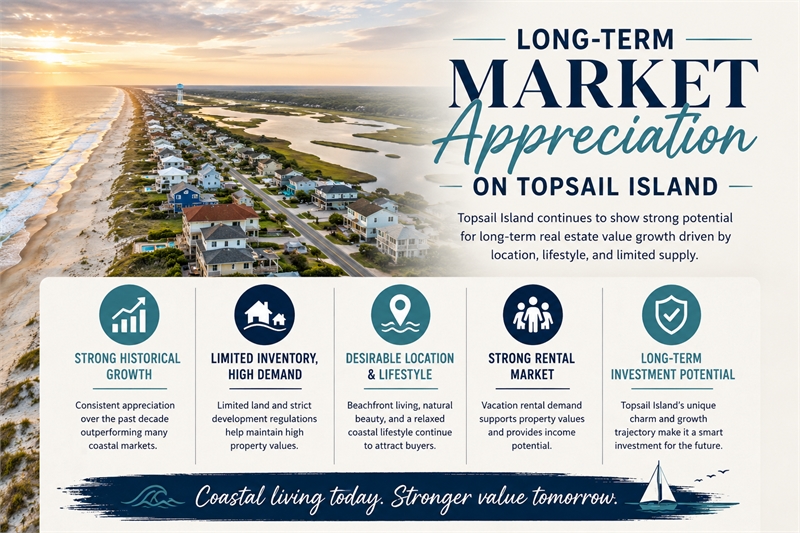
Why Growth Has Remained Steady Over the Past Decade
Over the past decade, Topsail Island has demonstrated a pattern of steady long-term market appreciation compared to many coastal destinations in North Carolina and the broader Southeast. While year-to-year pricing naturally fluctuates in any real estate market, Topsail Island has largely avoided the sharp volatility often associated with heavily overbuilt or aggressively marketed resort areas.
This stability has not occurred by chance. It reflects a combination of structural constraints, sustained buyer demand, evolving lifestyle preferences, and a development pattern that has remained more measured than in many comparable coastal markets.
Limited Inventory and Natural Supply Constraints
One of the most influential drivers of long-term appreciation on Topsail Island has been limited housing inventory.
As a barrier island, Topsail has fixed geographic boundaries. Expansion is naturally constrained by:
- The island’s physical size and shape
- Environmental protections and coastal regulations
- Zoning policies across Surf City, North Topsail Beach, and Topsail Beach
Unlike mainland markets that can expand outward in response to demand, Topsail Island operates within a finite footprint. This structural limitation restricts the pace at which new housing can be introduced, helping to maintain long-term balance between supply and demand.
Much of the island’s residential development is already established, particularly in oceanfront and soundside neighborhoods. This reduces the likelihood of sudden surges in inventory that can place downward pressure on values in other markets.
Increased Demand From Out-of-State Buyers
Over the last ten years, Topsail Island has attracted growing interest from out-of-state buyers, particularly from the Northeast, Mid-Atlantic, and Midwest regions.
Several broader trends have contributed to this shift:
- Increased mobility and relocation flexibility
- Greater awareness of southeastern coastal markets
- Interest in second homes and long-term coastal ownership
Compared to more widely publicized resort destinations, Topsail Island has maintained a lower national profile, which has helped attract buyers seeking coastal access without the density or commercialization found elsewhere. This steady inflow of external demand has supported appreciation while avoiding speculative spikes.
Growth in Short-Term Rental Demand
Short-term rental activity has expanded across many coastal markets, and Topsail Island is no exception. Over the past decade, increased visibility through online rental platforms has contributed to demand for properties capable of flexible use.
What differentiates Topsail Island is the balance between rental activity and owner use. Many properties are not operated as full-time investment inventory but instead serve as:
- Primary residences with occasional rental use
- Second homes rented seasonally
- Long-term holdings with limited rental exposure
This balance has allowed rental demand to support property values without fundamentally altering the island’s residential character.
Rising Interest in Coastal Lifestyle Living
Lifestyle-driven demand has played an increasingly important role in long-term appreciation.
Buyers today often prioritize:
- Proximity to the ocean
- Access to outdoor recreation
- Lower population density
- A slower, more residential pace of life
Topsail Island’s layout — featuring long stretches of residential zoning, limited high-rise development, and preserved natural areas — aligns well with these preferences. This has drawn not only vacation homeowners but also buyers considering semi-retirement, relocation, or long-term coastal living.
Avoidance of Overbuilding
One of the clearest reasons Topsail Island has avoided extreme volatility is its measured development pattern.
Unlike markets that experienced rapid condominium construction or high-rise expansion, Topsail Island has generally maintained:
- Low- to mid-rise development
- A mix of single-family homes, townhomes, and condominiums
- Community-scale growth rather than large master-planned resorts
This approach has helped prevent oversupply and the pricing instability that often follows periods of aggressive development.
Short-Term Fluctuations vs. Long-Term Trends
All real estate markets experience short-term changes influenced by:
- Interest rate cycles
- Broader economic conditions
- Seasonal buying patterns
On Topsail Island, these year-to-year fluctuations have generally occurred within a broader trend of gradual appreciation. Rather than dramatic peaks and corrections, the market has shown incremental growth over time, supporting longer-term ownership strategies.
Condominium Communities and Market Accessibility
Condominium communities play an important role in Topsail Island’s overall market structure.
Across Surf City and North Topsail Beach in particular, condominiums provide:
- Entry points for first-time coastal buyers
- Lower-maintenance ownership options
- Shared amenities and managed infrastructure
Many condominium communities offer direct beach access or ocean views, which contributes to long-term desirability. HOA-managed maintenance and shared governance also support consistency in upkeep, which can help stabilize values over time.
Broader Coastal Context
Within North Carolina’s coastal market landscape, Topsail Island occupies a middle position:
- Less urbanized than Wrightsville Beach
- Less commercialized than many resort-driven destinations
- More residential than seasonal-only vacation markets
This positioning has allowed Topsail Island to benefit from coastal demand trends without absorbing the extremes seen in more densely developed areas.
Long-Term Perspective
Long-term market appreciation on Topsail Island reflects a convergence of:
- Structural supply limitations
- Sustained, diversified demand
- Lifestyle-driven buyer interest
- Controlled development practices
While future market conditions will continue to evolve, the factors that have shaped appreciation over the past decade remain largely in place.
Frequently Asked Questions (FAQ)
Has Topsail Island experienced steady appreciation over time?
Yes. While prices fluctuate from year to year, Topsail Island has generally followed a pattern of gradual long-term appreciation rather than extreme boom-and-bust cycles.
Why doesn’t Topsail Island see the same volatility as some resort markets?
The island’s limited inventory, controlled development, and lower density reduce the risk of oversupply, which is a common cause of volatility in overbuilt resort areas.
Does short-term rental demand affect long-term values?
Short-term rental demand has contributed to overall interest in the market, but it is balanced by significant owner occupancy and long-term ownership, helping preserve residential stability.
Are condominiums an important part of the market?
Yes. Condominium communities provide accessible ownership options, often with beach access and shared amenities, and play a key role in maintaining market diversity.
Is Topsail Island primarily a vacation market?
While vacation use is common, Topsail Island also supports year-round residents, long-term homeowners, and relocation buyers, contributing to a more balanced market profile.
This guide is included in The Complete Buyer’s Guide to Topsail Island Real Estate, a broader resource designed to help buyers understand the local market, property options, and ownership considerations.
Keep reading