
Why Your Topsail Island Vacation Rental May Be Slow During Peak Season
A slow Topsail Island vacation rental during peak season does not always mean the market is weak. Pricing, photos, reviews, amenities, competition, calendar settings, and guest expectations may be holding the property back.
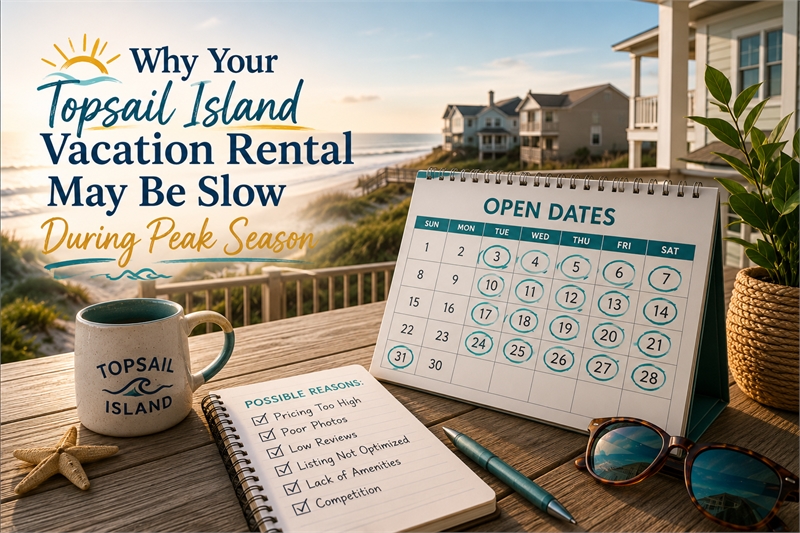
Peak season on Topsail Island should be the strongest time of year for most vacation rentals. Summer brings families, beach trips, fishing, boating, reunions, weekend getaways, and guests who are actively looking for places to stay near the ocean.
So when a vacation rental is slow during peak season, it can feel frustrating and confusing.
Many owners assume that if their property is available during summer, it should automatically book. But vacation rental performance is more complicated than that. Even in a strong beach market, some properties fill quickly while others sit with open dates. Sometimes the issue is pricing. Sometimes it is photos. Sometimes it is the layout, reviews, amenities, guest policies, location, availability, listing quality, or competition.
At Discover Topsail Island, our real estate and vacation rental articles are written from firsthand local experience. We understand Topsail Island as residents, licensed North Carolina real estate brokers, coastal property owners, vacation rental investors, and local small business owners. We know that peak season demand is real, but demand alone does not guarantee bookings.
If your Topsail Island vacation rental is slow during peak season, the key is not to panic. The better approach is to look honestly at the property, the listing, the pricing, the guest experience, and the competition.
This guide explains the most common reasons a Topsail Island vacation rental may be slow during peak season — and what owners should evaluate before assuming the market is the problem.
Peak Season Demand Does Not Mean Every Property Books Equally
Topsail Island has strong summer demand, but not every property benefits from that demand in the same way.
Guests compare options quickly. They may be looking at homes in North Topsail Beach, Surf City, Topsail Beach, Sneads Ferry, Hampstead, Wrightsville Beach, Carolina Beach, Emerald Isle, or the Outer Banks. They may be comparing oceanfront homes, condos, pet-friendly rentals, properties with pools, homes with elevators, newly renovated interiors, and listings with hundreds of reviews.
That means your property is not competing only with itself or with the house next door. It is competing with every other listing that shows up in the guest’s search.
A rental may be slow during peak season if competing properties offer:
- Better photos
- Better reviews
- Better pricing
- Better beach access
- More bedrooms
- A pool or hot tub
- Pet-friendly policies
- Updated interiors
- More flexible stays
- Easier parking
- Better listing descriptions
- Faster host communication
- Stronger cancellation policies
- Better perceived value
Peak season creates opportunity, but it also creates competition. Guests still choose the property that feels like the best fit for their trip and budget.
Your Pricing May Be Too High for the Current Competition
Pricing is one of the first things owners should review when a property is slow.
A high nightly rate is not automatically wrong. Some properties can command premium pricing because they have oceanfront location, great views, updated interiors, strong reviews, a pool, an elevator, luxury finishes, or a proven guest experience.
But if a property is priced like a premium listing without offering a premium experience, guests may move on.
Owners should compare pricing against similar properties, not just properties they wish they were competing with. A three-bedroom condo should not be priced only against a large oceanfront house. An older home with basic furnishings should not be priced like a fully renovated designer property. A property without a pool may not be able to match the rate of a similar home with a pool during certain summer weeks.
Pricing should be evaluated based on:
- Location
- Property type
- Bedroom count
- Bathroom count
- View
- Beach access
- Condition
- Amenities
- Reviews
- Photography
- Availability
- Minimum stay requirements
- Competing listings
- Booking pace
A property can be overpriced even during peak season. The market does not care what the owner needs the property to make. Guests respond to value.
Discounting Too Late Can Leave Money on the Table
Some owners wait too long to adjust pricing.
If a peak summer week is still open far in advance, it may not be a problem. Some guests book early, while others wait. But as the date gets closer, the pool of potential guests can shrink. Families need time to plan, request time off, coordinate schedules, arrange travel, and choose a property.
If pricing is too high for too long, strong guests may book somewhere else. By the time an owner discounts the property, the remaining guest pool may be smaller and more price-sensitive.
A better approach is to watch booking pace. If similar properties are booking and yours is not, it may be time to adjust before the calendar gap becomes a last-minute problem.
Smart pricing does not always mean deep discounts. It may mean:
- Adjusting rates earlier
- Creating small discounts for open gaps
- Offering better value for specific dates
- Loosening minimum stay rules
- Improving the listing before dropping price
- Matching pricing to competing inventory
- Protecting premium weeks while responding to slower ones
The goal is not to panic-price the property. The goal is to stay realistic and responsive.
Your Photos May Not Be Strong Enough
Photos are one of the biggest reasons a vacation rental underperforms.
Guests often decide whether to click within seconds. If the first photo does not create interest, they may never read the description. A strong Topsail Island rental should quickly show why the property is worth booking.
Common photo problems include:
- Dark rooms
- Poor angles
- Cluttered spaces
- Outdated furniture
- Missing beach views
- No exterior photos
- No parking photos
- Weak bedroom photos
- Bathrooms not shown clearly
- Outdoor spaces underrepresented
- Amenities not shown
- Photos that make rooms look smaller
- No clear sense of beach access
- Old photos that no longer match the property
On Topsail Island, guests want to understand the beach experience. They want to know how close the property is to the beach, what the views look like, where they will sleep, where they will park, where they will gather, and what the property feels like.
Good photos do not just make the property look pretty. They answer questions.
If your property is slow during peak season, review the first five listing photos carefully. Those images may be the difference between a guest clicking your listing or skipping over it.
The Property May Not Match Guest Expectations
Peak season guests often have high expectations because they are paying peak season rates.
If your property is priced for summer but still feels dated, worn, poorly stocked, uncomfortable, or incomplete, guests may choose another property that feels more ready for vacation.
Common guest expectation issues include:
- Worn furniture
- Old mattresses
- Uncomfortable sofas
- Outdated bedding
- Weak kitchen supplies
- Poor lighting
- Limited seating
- Rusty outdoor furniture
- Dirty or stained rugs
- Old TVs
- Weak Wi-Fi
- Dated bathrooms
- Musty odors
- Lack of beach-friendly storage
- Poor outdoor spaces
This does not mean every rental has to be luxury. Many guests are happy with a clean, comfortable, well-priced beach property. But the property needs to match the price.
A basic property can perform well if it is clean, honest, comfortable, and priced correctly. A premium-priced property needs to feel premium.
Your Reviews May Be Holding the Listing Back
Reviews matter.
Even if the property is in a great location, guests may hesitate if the listing has low ratings, limited reviews, or recent negative comments. During peak season, guests often spend more money and may be more cautious before booking.
Review concerns that can hurt bookings include:
- Cleanliness complaints
- Host communication complaints
- Maintenance issues
- Inaccurate listing details
- Check-in problems
- Noise complaints
- Parking problems
- Uncomfortable beds
- Broken appliances
- Odors
- Lack of supplies
- Refund disputes
A few negative reviews do not always ruin a listing, but patterns matter. If several guests mention the same issue, future guests will notice.
Owners should read reviews from the guest’s perspective. Do the reviews create confidence, or do they create hesitation?
If a property has review issues, the solution is not only to wait for better reviews. Owners should fix the underlying problems, update the listing honestly, communicate clearly, and make sure future guests have a better experience.
Cleaning Problems Can Quietly Damage Bookings
Cleaning issues are one of the fastest ways to hurt a vacation rental.
Guests may overlook small imperfections if the property is clean. They are much less forgiving when they arrive to sand, hair, odors, dirty bathrooms, stained linens, food crumbs, sticky floors, mildew, or trash.
Cleaning affects both reviews and repeat bookings. It also affects how guests talk about the property privately to friends and family.
On Topsail Island, cleaning can be especially challenging during peak season because of:
- Back-to-back turnovers
- Saturday traffic
- Sand
- Salt air
- Wet towels
- Beach gear
- Outdoor showers
- High guest volume
- Limited turnover windows
- Linen logistics
- Trash schedules
If your property is slow, look at whether past guests have mentioned cleanliness. Even one or two visible complaints can create hesitation for future guests.
A strong cleaning system should include turnover cleaning, inspections, deep cleaning, linen checks, supply restocking, maintenance reporting, and fast correction when something is missed.
Sleeping Arrangements May Not Fit the Market
Bedroom count matters, but sleeping arrangements matter too.
A property may technically sleep a certain number of guests, but that does not mean the layout feels comfortable or practical. Families want sleeping arrangements that make sense. They want beds that feel appropriate, rooms that function well, and enough bathrooms for the group.
Common sleeping arrangement problems include:
- Too many sleeper sofas
- Uncomfortable bunk rooms
- Not enough queen or king beds
- Bedrooms that feel cramped
- No clear photos of sleeping spaces
- Overstated sleeping capacity
- Limited privacy
- Not enough bathrooms
- Poor mattress quality
- Children’s sleeping areas that do not work well
Owners sometimes try to increase income by increasing the advertised guest count. That can backfire if the property feels overcrowded.
A better strategy is to make the layout clear, comfortable, and honest. Guests are more likely to book when they can easily picture their group staying there.
Pet Policies May Be Affecting Demand
Pet policies can affect bookings in both directions.
A pet-friendly property may attract more families because many beach travelers want to bring their dogs. In some cases, allowing pets can increase visibility and demand. However, pet-friendly rentals can also increase cleaning needs, odors, wear, and potential damage.
A no-pet policy may protect the property, but it may also reduce the guest pool.
There is no single right answer for every property. Owners should evaluate:
- HOA rules
- Flooring type
- Furniture durability
- Outdoor space
- Cleaning capacity
- Guest demand
- Pet fee structure
- Risk tolerance
- Competing listings
If similar properties are pet-friendly and yours is not, that could be one reason bookings are slower. But if your property is not set up for pets, allowing them without a plan can create bigger problems.
Pet strategy should be intentional, not emotional.
Missing Amenities May Be Hurting Your Listing
Amenities can strongly influence vacation rental demand.
During peak season, guests may compare properties based on features that make the trip easier, more comfortable, or more memorable. A property without certain amenities may still book, but it may need to be priced and presented accordingly.
Amenities that can influence bookings include:
- Pool access
- Hot tub
- Elevator
- Oceanfront location
- Ocean views
- Sound views
- Easy beach access
- Outdoor shower
- Covered parking
- Pet-friendly policy
- High-speed Wi-Fi
- Smart TVs
- Washer and dryer
- Grill, if allowed
- Outdoor seating
- Beach gear storage
- Family-friendly items
- Workspace
- Updated kitchen
- Updated bathrooms
Not every property needs every amenity. But owners need to understand how their property compares. A home without a pool may need a different pricing strategy than a similar home with a pool. A condo without an elevator may appeal to a different guest than one with easy elevator access.
The issue is not whether the property is good. The issue is whether the property is positioned correctly against the competition.
Location May Be Good, But Not Explained Well
A property may be in a great location, but guests may not understand that from the listing.
Topsail Island has different guest needs depending on where they want to stay. Some want the quiet feel of Topsail Beach. Some want the convenience of Surf City. Some want oceanfront value in North Topsail Beach. Some care about beach access, restaurants, grocery stores, boat ramps, fishing spots, public parking, playgrounds, or community amenities.
If your listing does not clearly explain the location advantage, guests may not see the value.
Owners should explain:
- Distance to beach access
- Parking situation
- Nearby restaurants
- Nearby grocery options
- Nearby public beach access
- Quiet vs active area
- Proximity to Surf City bridge
- Proximity to boat ramps
- Community amenities
- Walkability, if applicable
- Driving convenience
- Family-friendly features
Do not assume guests know the island. Many guests are comparing multiple beaches and may not understand why one part of Topsail Island is different from another.
A good listing helps guests picture the trip.
Minimum Stay Rules May Be Blocking Bookings
Minimum stay settings can affect booking activity.
During peak summer weeks, longer minimum stays may make sense. Many owners prefer weekly rentals because they reduce turnover pressure and match traditional beach vacation patterns. However, rigid minimum stays can also leave awkward calendar gaps that are difficult to fill.
For example, if a property has a four-night opening but a seven-night minimum, that gap may never book. If a guest wants a long weekend but the settings do not allow it, the listing may not even appear in their search.
Owners should review:
- Minimum stay rules
- Check-in and checkout day restrictions
- Gap night settings
- Weekend availability
- Last-minute flexibility
- Seasonal stay requirements
- Platform visibility
- Calendar gaps
Sometimes the issue is not demand. Sometimes the listing is not appearing for the guests who would book it because the calendar rules are too restrictive.
Strategic flexibility can help fill gaps without sacrificing the overall rental strategy.
Fees May Be Making the Total Price Feel Too High
Guests do not only look at nightly rate. They look at the total price.
A property may appear reasonably priced at first, but once cleaning fees, platform fees, taxes, pet fees, linen fees, administrative fees, and other charges are added, the total may feel too high compared to competing options.
Owners should review the guest-facing total, not just the nightly rate.
Questions to ask include:
- Is the cleaning fee reasonable for the property size?
- Are extra fees clearly explained?
- Does the total price match the property experience?
- Are similar properties offering better value?
- Does the property appear cheaper at first but expensive at checkout?
- Are fees causing guests to abandon the booking?
Fees may be necessary, but guests evaluate value based on the final number. If the final number feels too high for the property, bookings may slow down.
Slow or Weak Communication Can Cost Bookings
Guest communication matters before the booking is even confirmed.
If guests send questions and do not receive quick, clear answers, they may book somewhere else. This is especially true during peak season when families are comparing multiple options and trying to make decisions quickly.
Strong communication can help convert interested guests into bookings.
Owners or managers should respond quickly to questions about:
- Beach access
- Parking
- Pets
- Linens
- Check-in times
- Early check-in possibilities
- Pools and amenities
- Bed sizes
- Stairs or elevators
- Accessibility
- Distance to restaurants
- Family-friendly features
- Cancellation policies
- Local rules
Guests want confidence. If communication feels slow, unclear, or impersonal, they may not feel comfortable booking.
Your Listing May Not Be Optimized for How Guests Search
Vacation rental platforms are search engines.
Guests filter by dates, number of guests, bedrooms, amenities, pet policies, location, price, reviews, and property type. If your listing is missing accurate amenities or poorly written details, it may not appear in the right searches.
Listing optimization includes:
- Accurate title
- Strong first photo
- Clear description
- Complete amenity list
- Correct bedroom and bathroom details
- Pet policy accuracy
- Parking details
- Wi-Fi details
- Family-friendly details
- Updated photos
- Accurate map location
- Competitive pricing
- Good response rate
- Strong reviews
If your listing is incomplete or outdated, the platform may not work in your favor.
Owners should regularly review how their listing appears in search results. Search like a guest. Compare honestly. Ask whether your property stands out or blends in.
Maintenance Issues May Be Showing Through
Sometimes a property is slow because guests can sense that it is not well maintained.
This may show up in photos, reviews, or listing details. Worn paint, stained rugs, old furniture, broken blinds, rusty fixtures, damaged decking, mildew, dated bathrooms, and cluttered rooms can all reduce guest confidence.
Guests may think, “If this is what I can see online, what will I find when I arrive?”
Maintenance issues that affect bookings include:
- Worn exterior appearance
- Old or stained furniture
- Damaged flooring
- Peeling paint
- Broken screens
- Dirty windows
- Rusted fixtures
- Weak outdoor spaces
- Poor lighting
- Old appliances
- Visible clutter
- Tired bedding
- Outdated bathrooms
- Musty-looking interiors
Peak season guests are often paying premium rates. They want the property to feel worth it.
Small improvements can sometimes make a major difference in booking confidence.
Your Property May Be Overcrowded on Paper
Some vacation rentals try to sleep too many guests.
On paper, a higher guest count may seem like a way to increase income. In reality, overcrowding can hurt reviews, increase wear, create parking issues, strain plumbing and HVAC systems, and make the property feel less comfortable.
A property should sleep the number of guests it can comfortably handle, not the maximum number that can physically fit.
Owners should consider:
- Number of bathrooms
- Parking capacity
- Dining seating
- Living room seating
- Bedroom privacy
- HVAC capacity
- Water heater capacity
- HOA occupancy limits
- Local rules
- Guest comfort
A property that sleeps twelve but only parks two cars may create problems. A condo that advertises high occupancy but has limited space may disappoint guests. A beach house packed with too many beds may feel more like a dorm than a relaxing vacation home.
Better guest fit often leads to better reviews and stronger long-term performance.
The Property May Not Feel “Vacation Ready”
Guests book a Topsail Island vacation rental because they want an easy, enjoyable beach trip.
A property may be technically available, but still not feel vacation ready. That can happen when the listing lacks warmth, the photos feel flat, the furnishings feel random, the outdoor spaces are underused, or the property does not show a clear guest experience.
A vacation-ready property should feel:
- Clean
- Comfortable
- Easy to understand
- Well stocked
- Relaxing
- Beach appropriate
- Guest friendly
- Accurate online
- Simple to access
- Ready for families or groups
The best-performing rentals usually help guests imagine the trip before they arrive. They show where the family will gather, where the kids will sleep, where coffee will be enjoyed, where beach gear will go, and how easy the vacation will feel.
If the property does not create that feeling online, guests may keep scrolling.
The Market May Be Strong, But Your Segment May Be Softer
Sometimes the overall market is active, but a specific property segment is slower.
For example, demand may be strong for oceanfront homes but softer for older condos. Pet-friendly properties may be booking faster than no-pet properties. Homes with pools may be outperforming homes without pools. Updated interiors may be beating dated interiors. Flexible stays may be filling gaps while strict weekly rentals sit open.
Owners should look at their specific segment, not just the entire island.
Compare your property to similar rentals based on:
- Town
- Property type
- Bedroom count
- View
- Beach access
- Amenities
- Condition
- Reviews
- Pricing
- Policies
- Availability
If your segment is crowded or softer than expected, strategy matters even more. Pricing, photos, amenities, and guest experience must be competitive.
Do Not Assume the Problem Is Only the Platform
When bookings slow down, some owners immediately blame the platform.
Sometimes platform visibility can be part of the issue. Search placement, algorithm changes, response rates, reviews, pricing competitiveness, cancellation policies, and listing completeness can all affect visibility. But it is usually too simple to say, “The platform is the problem.”
Owners should review the full picture first:
- Are the photos strong?
- Is the price competitive?
- Are reviews helping or hurting?
- Are the amenities accurate?
- Is the calendar too restrictive?
- Is the property showing in searches?
- Is the description clear?
- Is the first photo compelling?
- Is the total price too high?
- Is the property competitive against similar listings?
The platform may influence visibility, but guests still respond to value, trust, and presentation.
What Owners Should Review First
If your Topsail Island vacation rental is slow during peak season, start with the most important factors:
- First photo
- Overall photo quality
- Price compared to similar properties
- Total guest-facing cost
- Recent reviews
- Cleaning comments
- Listing title
- Listing description
- Amenity accuracy
- Minimum stay settings
- Calendar gaps
- Pet policy
- Sleeping arrangements
- Parking information
- Beach access explanation
- Guest communication speed
- Maintenance condition
- Competing listings
This review should be honest. Owners are naturally attached to their properties, but guests only see what is presented online. If the listing does not clearly communicate value, guests may choose another option.
FAQ: Why a Topsail Island Vacation Rental May Be Slow During Peak Season
Why is my Topsail Island vacation rental not booking during summer?
A slow summer rental can be caused by pricing, weak photos, limited reviews, poor listing details, strict calendar settings, high fees, outdated furnishings, cleaning complaints, missing amenities, or strong competition. Peak season demand helps, but guests still compare value before booking.
Does a slow peak season mean the Topsail Island rental market is weak?
Not necessarily. The overall market may still be active while certain properties, price points, or segments perform slower. Owners should compare their property against similar rentals before assuming the entire market is down.
Can my vacation rental be overpriced even during peak season?
Yes. A property can be overpriced if the rate does not match the location, condition, amenities, reviews, photos, or guest experience. Peak season allows stronger pricing, but guests still expect value.
How important are photos for vacation rental bookings?
Photos are extremely important. Guests often decide whether to click based on the first few images. Poor lighting, clutter, weak angles, missing beach access photos, or outdated images can cause guests to skip the listing.
Do reviews affect peak season bookings?
Yes. Reviews can strongly affect guest confidence. Cleanliness complaints, maintenance issues, poor communication, inaccurate listing details, or uncomfortable beds can reduce bookings even when the property is available during high-demand weeks.
Can cleaning issues hurt future bookings?
Yes. Cleaning complaints are one of the most damaging review issues for vacation rentals. Guests are cautious when they see comments about dirty bathrooms, sand, odors, stained linens, or poor turnovers.
Should I lower my price if my rental is slow?
Price may need to be adjusted, but owners should first review photos, listing quality, calendar settings, fees, and competition. Sometimes a small pricing adjustment helps. Other times, improving presentation or flexibility may be more effective.
Can minimum stay rules hurt bookings?
Yes. Strict minimum stay rules can prevent the property from appearing in searches or filling calendar gaps. Weekly minimums may make sense during peak weeks, but owners should review whether settings are blocking shorter stays when gaps appear.
Do amenities really matter during peak season?
Yes. Guests may compare properties based on pools, hot tubs, elevators, pet policies, Wi-Fi, outdoor showers, parking, beach access, updated kitchens, outdoor seating, and family-friendly features. Missing amenities do not mean a property cannot book, but pricing and presentation should reflect the property’s offering.
Is being pet-friendly better for bookings?
It can be, depending on the property. Pet-friendly rentals may attract more guests, but they can also create additional wear, cleaning needs, and risk. Owners should consider HOA rules, flooring, furnishings, cleaning systems, and demand before changing pet policies.
How do I know if my listing is the problem?
Search like a guest. Compare your listing against similar properties with the same dates, guest count, bedroom count, amenities, and location. Look at your first photo, price, reviews, total cost, description, and calendar rules. If similar properties appear stronger, your listing may need work.
What should I fix first if bookings are slow?
Start with the items that most directly affect guest decisions: pricing, first photo, total cost, reviews, listing accuracy, beach access explanation, amenities, and calendar flexibility. These are often the fastest areas to improve.
When Peak Season Is Slow, Look at the Whole Picture
A slow Topsail Island vacation rental during peak season does not automatically mean the market is bad or the property is a failure. It usually means something needs to be reviewed.
The issue may be pricing. It may be photos. It may be reviews, amenities, calendar settings, cleaning quality, total cost, communication, or competition. In many cases, several small issues are working together.
The best owners do not panic. They evaluate the property like both a business and a real estate asset. They look at what guests see, what competitors offer, what reviews say, and whether the property is positioned correctly for the season.
Peak season demand creates opportunity, but the property still has to earn the booking.
If your Topsail Island vacation rental is slow during summer, the right adjustments can often make a meaningful difference — especially when they are based on honest review, local knowledge, and a clear understanding of how guests choose where to stay.
Keep reading