
Self-Management vs. Co-Hosting vs. Full-Service Property Management Topsail Island
Topsail Island vacation rental owners can choose self-management, co-hosting, or full-service property management. The right model depends on owner involvement, experience, location, systems, cost, guest expectations, and long-term goals.
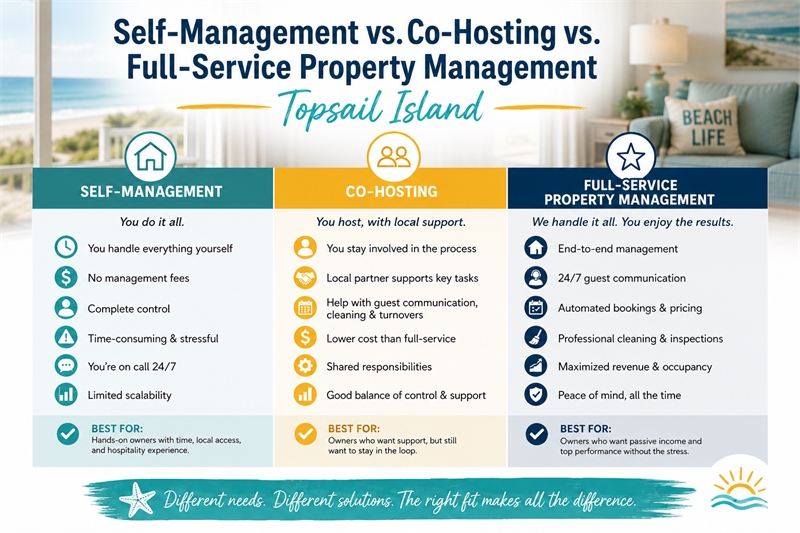
Owning a vacation rental on Topsail Island is not only about buying the right property.
It is also about choosing the right management structure.
Some owners want full control and prefer to self-manage everything. Others want to stay involved but need local help with guest communication, cleaning coordination, maintenance, pricing, inspections, and problem-solving. Some owners want a more traditional full-service property management model where a company handles most of the rental operation for them.
There is no single best answer for every owner.
The right choice depends on the property, the owner’s time, location, experience, systems, risk tolerance, rental goals, and expectations. A local owner with strong vendor relationships may be comfortable self-managing. An out-of-state owner may need more support. An investor who wants control over pricing and guest communication may prefer co-hosting. An owner who wants a more hands-off experience may prefer full-service management.
On Topsail Island, this decision matters because vacation rentals operate in a coastal environment with seasonal demand, guest expectations, cleaning pressure, maintenance challenges, insurance concerns, HOA rules, weather events, and heavy peak-season turnover. The management model affects not only income, but also reviews, property condition, owner stress, guest experience, and long-term value.
At Discover Topsail Island, our real estate and vacation rental articles are written from firsthand local experience. We understand Topsail Island as residents, licensed North Carolina real estate brokers, coastal property owners, vacation rental investors, and local small business owners. We know that successful vacation rental ownership depends on more than having a good listing. It requires the right systems behind the property.
This guide compares owner self-management, co-hosting, and full-service property management so Topsail Island vacation rental owners can better understand which approach may fit their goals.
Management Structure Should Be Decided Before the First Guest Books
Many owners buy a property first and figure out management later.
That can create problems.
Before purchasing or launching a Topsail Island vacation rental, owners should think carefully about who will handle the daily operations. Vacation rentals require more than simply listing the property online and waiting for bookings.
Someone needs to manage:
- Listing setup
- Photos and descriptions
- Pricing strategy
- Calendar management
- Guest communication
- Check-in instructions
- Cleaning coordination
- Linen systems
- Maintenance calls
- Vendor scheduling
- Reviews
- Supplies
- Refund requests
- Platform issues
- HOA rules
- Storm preparation
- Post-storm inspections
- Guest complaints
- Owner reporting
- Property updates
If no one is clearly responsible for these items, the rental can quickly become stressful.
A property may have strong income potential, but if the management structure is weak, the guest experience can suffer. That can lead to poor reviews, lower booking confidence, owner frustration, and unnecessary expenses.
The right management model should fit the property before the rental goes live.
What Is Owner Self-Management?
Owner self-management means the owner handles the vacation rental operation directly.
The owner may list the property on Airbnb, VRBO, direct booking platforms, or other channels and personally manage the major parts of the rental business. Some self-managing owners live nearby. Others manage remotely with the help of cleaners, vendors, smart locks, and digital tools.
Self-management may include:
- Creating the listing
- Setting pricing
- Responding to guest messages
- Managing the calendar
- Coordinating cleaners
- Scheduling maintenance
- Handling guest complaints
- Stocking supplies
- Reviewing reservations
- Managing taxes and records
- Updating photos and descriptions
- Handling platform disputes
- Monitoring reviews
- Making decisions about repairs and improvements
Self-management gives owners the most control, but it also requires the most responsibility.
For some owners, that is exactly what they want. For others, it becomes overwhelming once bookings, guest questions, cleaning issues, maintenance calls, and peak-season pressure increase.
Benefits of Self-Managing a Topsail Island Vacation Rental
Self-management can work well for owners who are organized, responsive, local or well-supported, and comfortable running the rental like a business.
Potential benefits include:
- More control over pricing
- More control over guest communication
- More control over listing presentation
- Direct knowledge of the property
- Direct relationship with guests
- No traditional management commission
- Flexibility in decisions
- Faster personal adjustments
- Better understanding of income and expenses
- Ability to build repeat guest relationships
Some owners enjoy being hands-on. They like controlling the guest experience, setting the tone, choosing vendors, adjusting rates, and staying directly involved in the property.
Self-management can also help owners understand the business more deeply. When an owner personally handles guest questions, cleaning feedback, repair issues, and reviews, they learn what guests actually care about.
That knowledge can be valuable.
Challenges of Self-Management
Self-management can also be demanding.
Vacation rentals do not always operate on a convenient schedule. Guest questions can come at night. Maintenance issues can happen during dinner. A lock code may fail after a long travel day. A cleaner may report damage hours before the next guest arrives. A storm may require immediate decisions. A guest may request a refund or complain about something unexpected.
Self-management challenges may include:
- Constant guest communication
- Late-night or weekend issues
- Cleaning coordination stress
- Maintenance emergencies
- Vendor scheduling
- Platform policy confusion
- Pricing mistakes
- Calendar mistakes
- Owner burnout
- Guest complaint handling
- Refund disputes
- Lack of local backup
- Difficulty inspecting the property
- Storm response challenges
- Inconsistent cleaning oversight
Self-management is not passive. It is an active role.
Owners who live far away may struggle if they do not have reliable local support. Even owners who live nearby can become overwhelmed during peak season if they manage multiple properties or have other business responsibilities.
Self-management can save management fees, but it costs time, energy, and availability.
Who Self-Management May Fit Best
Self-management may work best for owners who:
- Live locally or visit often
- Understand Topsail Island
- Have reliable cleaners
- Have strong vendor relationships
- Are responsive to guest messages
- Understand pricing and platforms
- Are comfortable with problem-solving
- Have time to manage the rental
- Want maximum control
- Can inspect the property regularly
- Are comfortable handling complaints
- Have backup support for emergencies
Self-management is usually a better fit for owners who treat the property like a business, not a casual side project.
It may not be ideal for owners who travel often, have limited time, dislike guest communication, live far away without local help, or want a truly hands-off investment.
What Is Vacation Rental Co-Hosting?
Co-hosting is a flexible management model that sits between self-management and full-service property management.
In a co-hosting arrangement, the owner usually stays involved while receiving help with important parts of the rental operation. The exact structure can vary, but co-hosting often includes support with guest communication, listing optimization, pricing, cleaning coordination, maintenance coordination, inspections, guest issues, local recommendations, and platform management.
Co-hosting may be especially appealing to owners who want:
- More control than traditional property management
- More support than self-management
- Local help
- Flexible involvement
- Assistance with guest communication
- Cleaning and maintenance coordination
- Better listing performance
- A more personal approach
- Owner-direct decision-making
- Help without giving up all control
Co-hosting can be structured around what the owner actually needs.
Some owners may want help only with guest communication and local coordination. Others may want a co-host to handle most day-to-day operations while the owner stays involved in major decisions.
The key difference is flexibility.
Benefits of Co-Hosting on Topsail Island
Co-hosting can be a strong fit for Topsail Island vacation rental owners who want support without fully stepping away from the property.
Potential benefits include:
- Owner keeps more involvement
- More flexible than traditional management
- Local support for guest issues
- Help with cleaning coordination
- Help with maintenance coordination
- Faster local problem-solving
- Guest communication support
- Listing improvement
- Pricing support
- Review management
- Better check-in and guest guidance
- Ability to preserve owner preferences
- More direct connection to the property
For Topsail Island owners, local support can be especially important.
A co-host familiar with the island may understand beach access, parking, guest expectations, cleaning challenges, HOA rules, seasonal traffic, storm preparation, local vendors, and common guest questions.
This local knowledge can improve guest experience and reduce owner stress.
Co-hosting can also help owners who want to self-manage in theory but need backup in practice.
Challenges of Co-Hosting
Co-hosting is flexible, but it still requires clear expectations.
Because co-hosting arrangements can vary, owners need to understand exactly what is included and what is not included.
Potential challenges include:
- Unclear responsibilities
- Confusion about who responds to guests
- Unclear maintenance approval process
- Different expectations about owner involvement
- Pricing disagreements
- Platform access concerns
- Cleaning responsibility confusion
- Vendor coordination questions
- Fee structure differences
- Need for clear communication
A good co-hosting relationship should be clearly defined.
Owners should know:
- Who controls pricing
- Who controls the calendar
- Who responds to guest messages
- Who coordinates cleaning
- Who handles maintenance calls
- Who approves repairs
- Who handles emergencies
- Who updates the listing
- Who manages reviews
- Who communicates with platforms
- What fees apply
- How often owner updates are provided
Co-hosting can work very well when expectations are clear. It can become frustrating when roles are vague.
Who Co-Hosting May Fit Best
Co-hosting may work best for owners who:
- Want to stay involved
- Want local support
- Want help without full-service management
- Prefer flexibility
- Want more control over the property
- Need guest communication support
- Need cleaning or maintenance coordination
- Live out of town but want direct involvement
- Own one or several rentals
- Want a more personalized management approach
- Are comfortable making owner decisions
- Want help improving rental performance
Co-hosting can be especially useful for owners who understand the value of support but do not want to hand over every part of the rental operation.
It can also fit owners who want to build a stronger direct rental brand or maintain more control over the guest experience.
What Is Full-Service Property Management?
Full-service property management is a more traditional model where a management company handles most of the rental operation.
Depending on the company and agreement, full-service management may include listing the property, marketing, booking, guest communication, cleaning coordination, maintenance coordination, revenue management, owner statements, tax collection, inspections, and guest support.
This model is designed for owners who want a more hands-off experience.
Full-service management may include:
- Marketing the property
- Managing reservations
- Guest communication
- Check-in and checkout processes
- Cleaning coordination
- Maintenance coordination
- Vendor management
- Rate management
- Owner statements
- Platform or website listing
- Guest support
- Review handling
- Some inspections
- Local office support, depending on company
For some owners, full-service management offers convenience and peace of mind. For others, it may feel too rigid or less personalized.
The quality of full-service management depends heavily on the company, systems, communication, fees, and level of attention given to the property.
Benefits of Full-Service Property Management
Full-service property management can be useful for owners who want to reduce day-to-day involvement.
Potential benefits include:
- More hands-off ownership
- Professional systems
- Established rental processes
- Guest communication handled
- Cleaning coordination handled
- Maintenance coordination handled
- Owner statements
- Local support
- Established marketing channels
- Less owner time required
- Support during peak season
- Potentially broader booking exposure
For out-of-area owners, full-service management may feel easier because one company is responsible for most operational tasks.
This can be especially helpful for owners who do not want to handle guest messages, cleaner scheduling, maintenance calls, pricing adjustments, or platform issues.
The main benefit is convenience.
Challenges of Full-Service Property Management
Full-service property management is not automatically the best fit for every owner.
Some owners feel they lose too much control. Others may be dissatisfied with communication, fees, maintenance costs, cleaning quality, pricing strategy, or how personally the property is handled.
Potential challenges include:
- Higher management fees
- Less owner control
- Less flexibility
- Standardized processes
- Slower owner communication
- Less personalized guest communication
- Markups or vendor coordination concerns
- Difficulty controlling listing details
- Less direct relationship with guests
- Possible disconnect between owner goals and manager strategy
- Limited transparency, depending on company
A full-service manager may handle many tasks, but owners should still stay informed. A property can be professionally managed and still require owner oversight.
Owners should review statements, guest reviews, maintenance records, cleaning quality, photos, pricing, and overall property condition regularly.
Hands-off should not mean unaware.
Who Full-Service Property Management May Fit Best
Full-service property management may work best for owners who:
- Want minimal daily involvement
- Live far from Topsail Island
- Do not want to communicate with guests
- Do not want to coordinate cleaners
- Do not have local vendors
- Prefer one company to handle operations
- Are comfortable paying management fees
- Do not need full control over every decision
- Own a property that fits the company’s system
- Want established rental infrastructure
This model may also fit owners who are not comfortable with vacation rental platforms, technology, pricing, or guest service.
For the right owner, full-service management can reduce stress. For the wrong owner, it can feel limiting.
Comparing Control, Cost, and Convenience
The three models differ most in control, cost, and convenience.
Self-management usually offers the most control and the lowest direct management cost, but it requires the most owner time and responsibility.
Co-hosting usually offers a balance. The owner stays involved while receiving support in specific areas. Costs vary depending on the services provided.
Full-service management usually offers the most convenience, but it often comes with higher fees and less direct control.
A simple comparison:
Self-management:
- Highest owner control
- Highest owner involvement
- Lowest direct management fees
- Highest time requirement
- Requires strong systems
Co-hosting:
- Shared involvement
- Flexible support
- Moderate cost depending on scope
- Local help available
- Owner retains more control
Full-service management:
- Lowest owner involvement
- Highest convenience
- Often higher fees
- Less direct control
- More standardized operation
The best choice depends on what the owner values most.
Guest Experience Should Drive the Decision
The management model should support the guest experience.
Guests do not care whether the property is self-managed, co-hosted, or fully managed. They care whether the stay is clean, accurate, comfortable, responsive, and easy.
A strong guest experience requires:
- Clear communication
- Clean property
- Accurate listing
- Easy check-in
- Reliable Wi-Fi
- Good maintenance response
- Helpful local information
- Comfortable furnishings
- Clear parking instructions
- Fair problem resolution
- Professional checkout process
Any management model can succeed if these items are handled well.
Any management model can fail if they are not.
Owners should choose the structure that gives guests the best experience while also fitting the owner’s needs.
Cleaning Coordination Is a Major Difference
Cleaning is one of the most important operational issues in a vacation rental.
Self-managing owners must find, schedule, communicate with, and oversee cleaners directly. That can work well with a strong cleaning team, but it requires attention.
Co-hosting may include cleaning coordination, inspection support, linen oversight, supply checks, and communication between cleaners and owners.
Full-service property management typically handles cleaning coordination through the company’s system, although quality can vary.
Cleaning affects:
- Reviews
- Guest satisfaction
- Refund requests
- Repeat bookings
- Property condition
- Maintenance reporting
- Owner stress
For Topsail Island rentals, cleaning is especially important because of sand, salt air, back-to-back summer turnovers, beach gear, trash, and high guest expectations.
Owners should not choose a management model without understanding exactly how cleaning will be handled.
Maintenance Response Matters More Than Owners Think
Maintenance can define the guest experience.
A broken air conditioner, clogged toilet, failed smart lock, appliance issue, leak, or Wi-Fi problem can quickly turn into a negative review if not handled well.
Self-managing owners need reliable vendors and availability to coordinate repairs. Co-hosting may provide local coordination and help identify problems quickly. Full-service management usually handles maintenance through established vendor relationships.
Owners should ask:
- Who takes maintenance calls?
- Who determines urgency?
- Who contacts vendors?
- Who approves repairs?
- What repair amount requires owner approval?
- How are emergency repairs handled?
- Are there vendor markups?
- How quickly are issues reported?
- Are photos or invoices provided?
- Who follows up with the guest?
Maintenance response is not only about fixing problems. It is about protecting reviews and property value.
Pricing Strategy Can Make or Break Performance
Pricing is another major difference between management models.
Self-managing owners control pricing directly. This can be a benefit if the owner understands market demand, seasonality, competing listings, and booking pace. It can be a problem if pricing is based on emotion or guesswork.
Co-hosting may include pricing support while the owner still stays involved in decisions.
Full-service property management may use company pricing systems, revenue management tools, or local experience, depending on the company.
Pricing should account for:
- Peak season demand
- Shoulder season demand
- Holidays
- Local events
- Property condition
- Reviews
- Amenities
- Beach access
- Competition
- Open calendar gaps
- Minimum stay rules
- Last-minute demand
A management model should help the property earn well without sacrificing guest fit, reviews, or long-term value.
Owner Involvement Should Be Honest
Owners should be honest about how involved they really want to be.
Some owners say they want to self-manage but do not want to answer guest messages. Some say they want full-service management but still want control over every detail. Some want co-hosting but are not clear about which responsibilities they want to keep.
Before choosing a model, owners should ask themselves:
- Do I want to talk to guests?
- Do I want to set pricing?
- Do I want to manage cleaners?
- Do I want to approve every repair?
- Do I want to handle emergencies?
- Do I want to update the listing?
- Do I want to inspect the property?
- Do I want to manage reviews?
- Do I want to be available on weekends?
- Do I want a hands-off investment?
- Do I want direct control?
The right model should match the owner’s real personality and availability, not just the owner’s ideal version of ownership.
Local Knowledge Matters on Topsail Island
Topsail Island is not a generic vacation rental market.
North Topsail Beach, Surf City, and Topsail Beach each have different guest patterns, property types, beach access, parking concerns, HOA issues, and rental expectations. A management approach that works in one area may need adjustments in another.
Local knowledge can help with:
- Guest recommendations
- Beach access explanations
- Parking guidance
- Vendor coordination
- Storm preparation
- Trash schedules
- HOA rules
- Local events
- Restaurant suggestions
- Peak season traffic
- Shoulder season opportunities
- Coastal maintenance issues
- Owner expectations
This matters in every management model.
A self-managing owner needs to learn the island. A co-host should bring local support. A full-service manager should understand the local market deeply.
Vacation rental success is often built on practical local details.
Platform Management and Direct Booking Considerations
Vacation rental owners may use Airbnb, VRBO, direct booking websites, property management websites, or a combination of channels.
Self-managing owners may have full access and control over platform accounts. This can be helpful for building reviews, repeat guests, and owner-controlled listings. It also means the owner must understand platform policies and communication expectations.
Co-hosting may allow the owner to retain account ownership while receiving operational help. This can be attractive for owners who want to build their own listing history and brand.
Full-service management may place the property under the management company’s system or website, depending on the company’s structure. Owners should understand who owns the listing, reviews, photography, descriptions, and guest data.
Important questions include:
- Who owns the Airbnb or VRBO listing?
- Who controls reviews?
- Who controls photos and descriptions?
- Can the owner use direct bookings?
- Can the owner block personal dates?
- Who controls pricing?
- What happens if the agreement ends?
- Can reviews or listing history transfer?
- Who communicates with guests?
- Who collects payments?
These details matter before signing any agreement.
Fees Should Be Compared Against Value, Not Just Percentage
Management fees are important, but owners should look beyond the percentage.
A lower fee is not always better if the service is weak. A higher fee is not automatically bad if it produces better income, better reviews, less stress, stronger maintenance oversight, and better long-term property care.
Owners should consider:
- What services are included
- What services cost extra
- Cleaning fees
- Maintenance coordination fees
- Vendor markups
- Credit card fees
- Platform fees
- Linen fees
- Inspection fees
- Marketing costs
- Photography costs
- Owner reporting
- Contract terms
- Termination terms
- Listing ownership
- Revenue performance
- Guest experience
The right question is not only, “What does it cost?”
The better question is, “What value does this management structure provide?”
A management model should protect income, time, reviews, and the property itself.
Red Flags Owners Should Watch For
Before choosing any management structure, owners should watch for red flags.
Possible red flags include:
- Vague responsibilities
- Unclear fee structure
- Poor communication
- No clear cleaning process
- No maintenance approval process
- No local support
- Weak listing photos
- Poor review history
- No pricing strategy
- No owner reporting
- Overpromising income
- Lack of transparency
- No clear agreement
- Confusing termination terms
- Unclear listing ownership
- Poor understanding of HOA rules
- No storm plan
- No backup support
Vacation rental management should not feel uncertain. Owners should know exactly who is doing what and how problems will be handled.
Clear expectations protect both the owner and the guest.
Questions to Ask Before Choosing a Management Model
Before deciding between self-management, co-hosting, and full-service property management, owners should ask:
- How much control do I want?
- How much time do I have?
- Am I local or out of town?
- Do I have reliable cleaners?
- Do I have reliable maintenance vendors?
- Do I understand vacation rental pricing?
- Do I want to communicate with guests?
- Do I want help with listing optimization?
- Who will inspect the property?
- Who will handle emergencies?
- Who will manage reviews?
- Who will update photos and descriptions?
- Who will handle HOA issues?
- Who will prepare for storms?
- Who will coordinate repairs?
- What fees apply?
- Who owns the listing?
- What happens if I want to change models later?
These questions help owners choose a structure that fits reality.
Practical Comparison: Self-Management, Co-Hosting, and Full-Service Management
The best model depends on owner goals, property type, and available support.
Self-management may be best when:
- The owner wants control
- The owner has time
- The owner is local or has strong local help
- The owner understands guest communication
- The owner has cleaners and vendors
- The owner wants to reduce management fees
Co-hosting may be best when:
- The owner wants control plus support
- The owner needs local help
- The owner wants flexible services
- The owner wants guest communication support
- The owner wants help with cleaning and maintenance coordination
- The owner prefers a more personal management structure
Full-service management may be best when:
- The owner wants a hands-off approach
- The owner lives far away
- The owner does not want to manage guests
- The owner wants one company handling most operations
- The owner is comfortable with higher fees
- The owner values convenience over control
No model is perfect. The best model is the one that fits the owner and protects the guest experience.
FAQ: Self-Management, Co-Hosting, and Full-Service Property Management on Topsail Island
What is the difference between self-management, co-hosting, and full-service property management?
Self-management means the owner handles the rental directly. Co-hosting means the owner stays involved but receives help with specific parts of the rental operation. Full-service property management means a company handles most of the rental process for the owner.
Is self-managing a Topsail Island vacation rental realistic?
Yes, self-management can work for organized owners who have time, reliable cleaners, local vendors, strong communication skills, and good systems. It is more difficult for owners who live far away or cannot respond quickly to guest and maintenance issues.
What is vacation rental co-hosting?
Co-hosting is a flexible support model where someone helps the owner manage parts of the vacation rental. This may include guest communication, cleaning coordination, pricing, maintenance coordination, listing updates, inspections, and local support.
Is co-hosting better than full-service property management?
Not always. Co-hosting may be better for owners who want more control and flexibility. Full-service management may be better for owners who want a more hands-off experience. The better choice depends on the owner’s goals, time, and desired involvement.
What does full-service property management include?
Full-service property management often includes marketing, reservations, guest communication, cleaning coordination, maintenance coordination, pricing, owner statements, and guest support. Exact services vary by company and agreement.
Which management model gives owners the most control?
Self-management gives owners the most control. Co-hosting usually provides a balance of control and support. Full-service property management usually gives owners less daily control but more convenience.
Which option is best for out-of-state owners?
Out-of-state owners often need either co-hosting or full-service property management unless they have strong local support. The right choice depends on how involved they want to remain in guest communication, pricing, and property decisions.
Is full-service property management worth the cost?
It can be worth the cost for owners who value convenience, do not want daily involvement, and trust the company’s systems. Owners should compare fees against value, service quality, transparency, rental performance, and property care.
Why is local support important for Topsail Island rentals?
Local support matters because vacation rentals may need cleaning inspections, maintenance response, storm preparation, guest help, parking guidance, HOA coordination, and quick problem-solving. Local knowledge can improve both guest experience and owner confidence.
Who handles cleaning in each management model?
In self-management, the owner usually coordinates cleaning directly. In co-hosting, the co-host may help coordinate or oversee cleaning. In full-service management, the management company typically handles cleaning through its own systems or vendors.
Can I switch from full-service management to self-management or co-hosting?
Often, yes, but it depends on the management agreement. Owners should review contract terms, termination provisions, listing ownership, review history, photography rights, and guest data before changing models.
What is the biggest mistake owners make when choosing a management model?
One of the biggest mistakes is choosing based only on fees. Owners should also consider guest experience, cleaning quality, maintenance response, local support, owner control, transparency, reviews, and long-term property condition.
Choose the Model That Fits the Property and the Owner
There is no single right way to manage a Topsail Island vacation rental.
Self-management can work well for owners who want control and have the time, systems, and support to operate the property directly. Co-hosting can be a strong middle ground for owners who want flexibility, local help, and continued involvement. Full-service property management can make sense for owners who want convenience and prefer a more hands-off approach.
The best choice is the one that supports the owner’s goals while protecting the guest experience, rental income, property condition, and long-term value.
A Topsail Island vacation rental is not just a listing. It is a coastal property, a guest experience, and an investment. The management structure should reflect that.
Whether an owner chooses self-management, co-hosting, or full-service property management, the goal should be the same: a clean, well-maintained, well-communicated, guest-ready property that performs consistently and protects the asset over time.
Keep reading