
Protecting Your Payouts: Airbnb Scams and Account Security for Topsail Island Rental
Airbnb payout scams can threaten rental income, especially for busy Topsail Island owners. Learn how to protect your account, payments, listings, and guest communication.
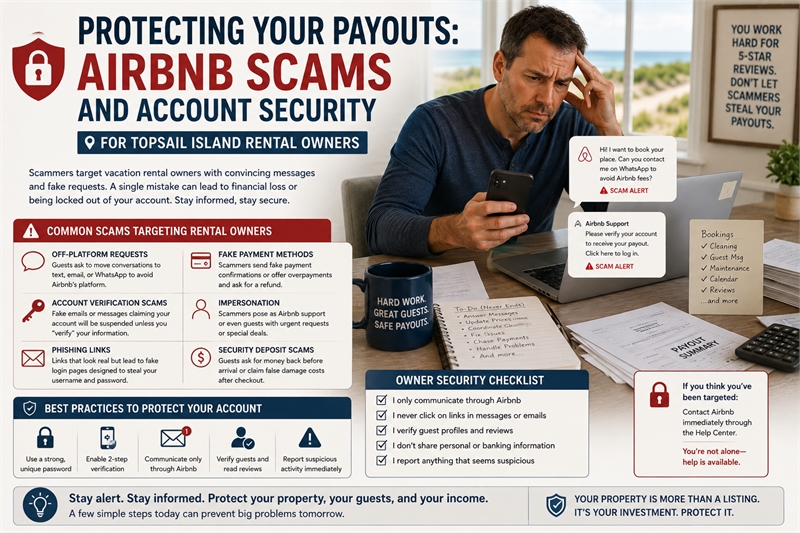
For many Topsail Island vacation rental owners, Airbnb is more than a booking platform. It is a major part of the property’s income stream. Whether you own a beachfront home in North Topsail Beach, a condo in Surf City, or a quiet rental cottage in Topsail Beach, your Airbnb account connects directly to your bookings, guest communication, payout settings, reviews, listing visibility, and rental revenue.
That makes account security extremely important.
A hacked or compromised Airbnb account is not just an inconvenience. It can put your rental income, guest relationships, listing reputation, and future bookings at risk. If someone gains access to your account, they may attempt to change payout details, redirect communication, manipulate reservations, send fraudulent messages, or interfere with your listing.
For Topsail Island rental owners, this can be especially damaging during peak season when bookings are frequent, payouts are larger, and owners are juggling cleaning schedules, guest arrivals, maintenance calls, and back-to-back turnovers. A scammer does not need much time to create a serious problem.
As a local Topsail Island property owner, vacation rental investor, and licensed North Carolina real estate broker, I believe account security should be treated as part of vacation rental management. Owners often focus on cleaning, pricing, maintenance, and guest experience, but payout protection deserves the same level of attention.
If your rental income runs through Airbnb, your account is part of your business. It needs to be protected like one.
Why Airbnb Account Security Matters for Vacation Rental Owners
Airbnb scams are not only aimed at guests. Hosts and rental owners can also be targeted.
For owners, the most serious risks are usually tied to account access, payout methods, fake messages, phishing links, fraudulent support requests, and off-platform communication. A scammer may try to trick an owner into clicking a fake link, entering login information on a fake website, sharing a verification code, or changing payout details.
The goal is often simple: gain access to the account or redirect money.
For a Topsail Island vacation rental owner, the financial risk can be significant. Summer bookings, holiday stays, and multi-night reservations may produce large payouts. If a payout method is changed or an account is compromised, the owner may not notice until money is delayed, missing, or routed incorrectly.
This is why owners should not treat account security as an afterthought. The same way you protect your property with locks, insurance, inspections, and maintenance, you should protect your Airbnb account with strong login practices, payout monitoring, and careful communication habits.
The Most Common Airbnb Scams Owners Should Watch For
While scams can take different forms, many of them rely on the same basic strategy: getting the owner to trust something that looks official, urgent, or financially important.
Common scams may include:
Fake Airbnb emails asking you to verify your account
Fake login pages designed to steal your password
Messages claiming there is a payout problem
Requests to update banking information through a link
Fake customer support representatives
Suspicious texts pretending to be Airbnb
Guests asking to communicate outside the platform before booking
Requests for refunds or payments outside Airbnb
Messages asking for your email, phone number, or verification code
Fake websites that look similar to Airbnb
Some scams are obvious. Others are not. Scammers know how to make messages look professional. They may use logos, urgent wording, fake warnings, or realistic-looking links.
For busy rental owners, the risk increases when you are moving fast. If you are handling turnovers, guest questions, cleaners, maintenance, and pricing all at once, it becomes easier to click something without slowing down.
That is exactly what scammers are counting on.
Payout Method Fraud: The Risk Owners Cannot Ignore
One of the most serious Airbnb-related scams for hosts involves payout methods.
Your payout method is where your rental income is sent. If a scammer gains access to your account and changes the payout information, your money could potentially be routed somewhere else. This is why owners should regularly review payout settings and watch for any unexpected changes.
A payout scam may begin with a phishing email that says there is a problem with your payment method. The message may ask you to click a link and log in. If the link leads to a fake page, your login information may be stolen.
Another version may involve a fake support message claiming your account needs verification before payouts can continue. The goal is to pressure you into acting quickly.
This is where owners need to pause.
Airbnb payout problems should be reviewed directly from your Airbnb account, not through random links in emails, texts, or messages. If something feels off, go to the platform directly by typing the address yourself or using the official app. Do not trust a link just because it looks professional.
Phishing Links Are One of the Biggest Threats
Phishing is one of the most common ways scammers try to steal account access.
A phishing message is designed to look legitimate. It may appear to come from Airbnb, a guest, a support representative, or another trusted source. The message may tell you that your account is locked, your payout failed, your listing is at risk, or your identity needs to be verified.
The scam usually includes a link.
That link may lead to a fake login page where you are asked to enter your email, password, phone number, verification code, or banking details. Once you enter that information, the scammer may use it to access your real account.
Topsail Island rental owners should be especially careful during high-volume booking periods. Scammers often rely on urgency. They want you to react quickly instead of thinking carefully.
A simple rule helps: do not log in through links you were not expecting.
If you receive a message about your Airbnb account, open Airbnb directly from the app or your browser and check your account there.
Never Share Verification Codes
Verification codes are designed to protect your account. They should not be shared with anyone.
A common scam involves someone pretending to be from customer support and asking for a code that was sent to your phone or email. They may say they need the code to verify your identity, fix a payout issue, unlock your account, or confirm a reservation.
Do not provide it.
If someone has your password and convinces you to give them the verification code, they may be able to get into your account. The code is often the final barrier between the scammer and your account access.
This is one of the most important security habits for rental owners: no legitimate support process should require you to casually hand over a one-time security code through an unsolicited message.
Keep Communication and Payments on the Platform
One of the best ways to reduce risk is to keep communication and payments on Airbnb, especially before a booking is accepted.
When conversations move off-platform too early, owners lose the protection of a clear message history. It becomes harder to prove what was said, what was requested, and whether something was suspicious.
This matters for both guests and owners.
A scammer may try to move communication to text, email, WhatsApp, Facebook, or another platform. They may claim it is easier, faster, or necessary. They may also ask for special payment arrangements, refunds outside the platform, or direct payment links.
For Topsail Island owners, direct bookings may be part of a broader rental strategy, but they should be handled carefully with proper systems, documentation, payment processing, and legal protections. A random guest asking to bypass Airbnb is not the same as a properly managed direct booking.
If the inquiry starts on Airbnb, owners should be very cautious about moving the conversation or payment outside Airbnb before the reservation is properly handled.
Strong Passwords Are Not Optional
A weak password can put your rental income at risk.
Vacation rental owners should avoid using the same password across multiple platforms. If your email, social media, banking, or other account password is reused on Airbnb, one data breach elsewhere could create risk for your rental account.
A strong password should be unique, difficult to guess, and stored securely. Owners should consider using a reputable password manager so they are not relying on memory or repeating the same passwords across accounts.
This matters because many rental owners use multiple systems: Airbnb, VRBO, direct booking websites, email, smart locks, accounting software, cleaning apps, channel managers, bank accounts, and social media pages.
Each connected system can become a weak point if passwords are reused or shared too casually.
Use Two-Factor Authentication or Passkeys When Available
Two-factor authentication adds another layer of protection to your account. Instead of relying only on a password, it requires an additional verification step.
This is important because passwords can be stolen, guessed, reused, or accidentally entered into fake websites. Two-factor authentication makes it harder for someone to access the account even if they have the password.
Passkeys can also help reduce password-related risk where available because they allow authentication without relying on a traditional password in the same way.
For Topsail Island rental owners, this is a simple but important step. If your Airbnb account controls guest communication and rental payouts, it should have stronger protection than a basic password alone.
Protect the Email Account Connected to Airbnb
Your Airbnb security is only as strong as the email account connected to it.
If a scammer gains access to your email, they may be able to reset passwords, intercept alerts, review reservation details, or watch for payout-related messages. This makes email security critical.
Owners should use a strong, unique email password and enable two-factor authentication on the email account as well. They should also review recovery phone numbers, backup email addresses, and account recovery settings.
This is especially important if multiple people help manage the rental. If a spouse, assistant, co-host, cleaner, or manager has access to messages or systems, owners need clear rules for who can access what.
The fewer people with full account access, the lower the risk.
Be Careful With Co-Host and Team Access
Many vacation rental owners use co-hosts, cleaners, assistants, or managers to help operate their property. This can be helpful, but access should be handled carefully.
Not everyone needs full account control.
Owners should avoid sharing personal login credentials whenever possible. If a platform allows separate roles or limited access, that is usually safer than giving someone the main account password.
The goal is to give people only the access they need to do their job. A cleaner may need turnover details but not payout settings. A maintenance vendor may need scheduling information but not guest messages. A co-host may need communication access but not unrestricted control over banking information.
For Topsail Island rentals, where multiple vendors may be involved during peak season, access discipline matters. Convenience should not come at the expense of account security.
Monitor Payouts Like a Business Owner
Vacation rental payouts should be reviewed regularly.
Owners should know when payouts are expected, what reservations they are tied to, and whether the amounts make sense. If a payout is delayed, missing, or unusual, it should be investigated quickly.
This is especially important during summer when back-to-back bookings can create a steady flow of payouts. If owners are not paying attention, it may take longer to catch a problem.
A simple monthly review is not always enough during peak season. Owners should check earnings, reservations, payout status, and payout methods more frequently when booking volume is high.
This does not have to be complicated. It just needs to be consistent.
Watch for Changes You Did Not Make
Owners should pay close attention to unexpected changes in their Airbnb account.
Warning signs may include:
A changed payout method
A changed phone number or email address
Unexpected login alerts
Messages you did not send
Reservation changes you did not approve
Guest complaints about strange communication
Missing or delayed payouts
Listing edits you did not make
Password reset emails you did not request
A new device accessing the account
If something looks wrong, act quickly. Do not assume it is a platform glitch or harmless mistake. A small warning sign can be the first indication that someone else has access.
Why Peak Season Creates More Risk
Topsail Island peak season can make account security more difficult because owners are busier.
During the summer, owners may be handling same-day turnovers, guest arrivals, cleaning issues, trash schedules, linens, maintenance calls, HVAC problems, appliance issues, parking questions, and last-minute booking inquiries. This creates the perfect environment for rushed decisions.
Scammers use urgency because it works.
A message that says “Your payout is blocked” or “Your account will be suspended” can feel alarming when you are expecting rental income. A fake guest message may seem believable when you are used to answering inquiries quickly. A suspicious link may get clicked because you are trying to solve a problem fast.
That is why owners need habits, not just awareness.
The habit should be simple: slow down, verify directly, and do not trust unexpected links or requests.
How Account Security Affects Guest Trust
Account security is not only about protecting payouts. It also protects your guests.
If a scammer gains access to an owner’s account, guests may receive fraudulent messages, fake payment requests, or incorrect instructions. This can damage trust immediately.
For vacation rental owners, trust is everything. Guests are booking a place for their family vacation. They want to feel confident that the listing is real, the communication is accurate, and the stay will go smoothly.
If guests receive strange messages or conflicting information, they may become nervous about the reservation. That can lead to cancellations, complaints, support cases, bad reviews, or damage to the property’s reputation.
Protecting your account helps protect your guest experience.
Direct Booking Websites Need Security Too
Many Topsail Island rental owners eventually consider direct bookings. Direct bookings can reduce platform fees and help build repeat guest relationships, but they also require strong systems.
A direct booking website should have secure payment processing, clear rental agreements, written cancellation policies, fraud prevention tools, and a professional communication process. Owners should be careful about accepting payments casually through methods that do not provide adequate documentation or protection.
Direct booking can be a strong strategy, but it should not be handled loosely.
If an owner is going to accept direct bookings, the process should feel as professional and secure as the platform experience. Guests need confidence, and owners need protection.
What to Do If You Suspect Your Airbnb Account Was Compromised
If you believe your Airbnb account has been accessed without permission, you should act immediately.
Start by going directly to Airbnb through the official app or website. Do not use links from suspicious emails or texts. Review your account information, payout methods, phone number, email address, login activity, messages, and reservations.
Change your password immediately if you still have access. Also change the password on your connected email account, especially if there is any chance it may be compromised.
Review payout settings carefully. Look for any bank account, payment method, or payout destination you do not recognize.
Check recent messages to see if anything was sent to guests without your knowledge.
Contact Airbnb support directly through official channels and report the issue.
If a fake website or suspicious message was involved, report it.
The key is speed. The sooner you catch and report suspicious activity, the better chance you have of limiting damage.
Account Security Should Be Part of Your Management System
Many owners think of vacation rental management in terms of cleaning, maintenance, pricing, and reviews. But account security belongs in that same category.
A strong management system should include:
Secure passwords
Two-factor authentication or passkeys
Protected email access
Regular payout reviews
Limited account access
Careful co-host permissions
Suspicious message reporting
Clear rules for direct bookings
Guest communication kept on-platform when appropriate
Routine review of payout methods and account settings
These steps are not complicated, but they require consistency.
For Topsail Island owners, especially those managing from out of town, account security should be part of the routine. The property may be at the beach, but the income depends on digital systems that need to be protected.
A Local Perspective for Topsail Island Rental Owners
Topsail Island vacation rentals are valuable assets. They are also active businesses. Between guest expectations, coastal maintenance, cleaning standards, pricing pressure, reviews, and storm-related concerns, owners already have a lot to manage.
Account security may not feel urgent until something goes wrong. But once a payout problem or account takeover happens, it can become stressful very quickly.
As a local rental owner and licensed North Carolina real estate broker, I believe owners should protect their Airbnb account the same way they protect their property. You would not leave the front door unlocked during peak season. You should not leave your payout system vulnerable either.
Whether you self-manage, use a co-host, or work with a property management company, make sure someone is responsible for monitoring account security and payout integrity.
Protecting the Income Behind the Investment
A Topsail Island vacation rental can be a strong investment, but only if the income stream is protected. Airbnb payout scams, phishing messages, fake websites, account takeovers, and off-platform fraud can all create real risk for owners who are not paying attention.
The good news is that many of these risks can be reduced with simple habits: use strong passwords, enable extra security protections, avoid suspicious links, keep communication and payments on-platform when appropriate, monitor payout methods, limit account access, and act quickly if something looks wrong.
Your rental income deserves the same level of protection as the property itself. For Topsail Island vacation rental owners, account security is not just a technical issue. It is part of protecting your investment, your guests, your reputation, and your long-term success.
Frequently Asked Questions About Airbnb Payout Scams and Account Security
Can Airbnb hosts be targeted by scams?
Yes. Hosts and rental owners can be targeted through phishing emails, fake support messages, suspicious links, payout method scams, fake websites, and attempts to move communication or payment off-platform.
What is an Airbnb payout scam?
An Airbnb payout scam is any attempt to interfere with or redirect the money a host earns from reservations. This may involve fake payout emails, stolen login credentials, unauthorized payout method changes, or fraudulent account access.
How can I tell if an Airbnb email is fake?
Be cautious with emails that create urgency, ask you to click a link, request login details, mention payout problems, or ask for personal information. The safest step is to go directly to Airbnb through the official app or website instead of clicking links in unexpected messages.
Should I ever share an Airbnb verification code?
No. Verification codes should not be shared with anyone through messages, texts, phone calls, or emails. A scammer may use the code to access your account.
What should I do if my payout method changes unexpectedly?
Log in directly through the official Airbnb app or website and review your payout settings immediately. If you did not make the change, contact Airbnb support through official channels and secure your account.
Is it safe to communicate with guests outside Airbnb?
Owners should be careful, especially before a booking is accepted. Keeping communication on Airbnb creates a clearer record and helps reduce fraud risk. Direct booking can be useful, but it should be handled through a professional and secure system.
Why is two-factor authentication important for Airbnb hosts?
Two-factor authentication adds another layer of protection beyond the password. This makes it harder for someone to access the account even if the password is stolen or guessed.
Should I use the same password for Airbnb and other accounts?
No. Your Airbnb password should be unique. Reusing passwords across email, banking, social media, and rental platforms increases the risk that one compromised account can lead to another.
Can a hacked email account affect my Airbnb account?
Yes. If someone gains access to the email connected to your Airbnb account, they may be able to intercept alerts, reset passwords, or access sensitive information. Your email account should also have a strong password and extra security protection.
How often should I check my Airbnb payouts?
Owners should review payouts regularly, especially during peak season. You should know what reservations payouts are tied to, when money is expected, and whether the payout method is correct.
Can co-hosts create account security risks?
They can if access is not managed carefully. Owners should avoid sharing full login credentials when possible and should only give co-hosts or helpers the access they actually need.
What should Topsail Island owners do during peak season to protect payouts?
During peak season, owners should be especially careful with suspicious messages, payout alerts, account changes, and login activity. Busy turnover schedules make it easier to overlook warning signs, so payout and account reviews should be part of the regular management routine.
Keep reading